
Develop your identity as a world-class, culturally responsive artist-therapist and counselor
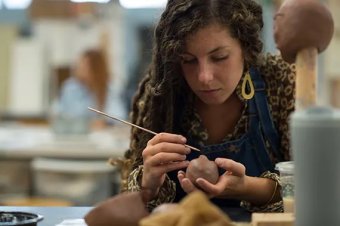
Counseling is a mental health profession in which a counselor builds a professional relationship to empower diverse individuals, families and groups to support mental health and wellness.
Art therapy is a mental health profession in which an art therapist facilitates client engagement in creative processes of art making and understanding resulting artworks for wellness and mental health.
We prepare all graduates to seek Professional Counselor Licensure and Registered Art Therapist Credentials.
Mission and Goals
As passionate, creative, and highly skilled educators, we aim to provide comprehensive, engaging, and in-depth counseling and art therapy education. Our students develop strong counselor-artist-therapist identities through growth-oriented and reflective classroom, studio, community, and clinical experience. We prepare world-class counselors and art therapists, who are culturally responsive, community-involved, ethical professionals with successful careers.
Counseling & Art Therapy will be recognized for excellence, integrity, and innovation in counseling and art therapy education.
- Prepare competent entry-level Counselors in the knowledge, skills, awareness, actions, and professional dispositions learning domains.
- Prepare competent entry-level Counselors in the cognitive (knowledge), psychomotor (skills), and affective (attitudes & behavior) learning domains.
- Prepare counselors and art therapists with clinical competence in assessment, diagnosis, and treatment planning, which includes fostering skills in the therapeutic use of a broad range of art processes and materials, integrative theoretical approaches, and requisite education needed for counseling licensure.
- Prepare counselors and art therapists to speak and write professionally about mental health services.
- Encourage students to develop an innovative, professional, ethical, research-minded, and culturally responsive approach to counseling and art therapy through academic inquiry personal art-making, and self-reflection for self-awareness.
The accomplishment of our goals will serve the:
- Student, by fostering personal and professional discovery and development with the skills to become lifelong learners.
- Client/patient, through student preparation to provide competent client/patient-centered primary and specialty care.
- Institution, by contributing to a seamless learning environment that fosters the development of competent and compassionate mental healthcare professionals.
- Community, by graduating professionals who understand the importance of community service, forging community alliances, and understanding culturally appropriate care.
- World, by graduating culturally humble professionals who practice across the globe and contribute to research and social action.
As passionate, creative, and highly skilled educators, we aim to provide comprehensive, engaging, and in-depth counseling and art therapy education. Our students develop strong counselor-artist-therapist identities through growth-oriented and reflective classroom, studio, community, and clinical experience. We prepare world-class counselors and art therapists, who are culturally responsive, community-involved, ethical professionals with successful careers.
Counseling & Art Therapy will be recognized for excellence, integrity, and innovation in counseling and art therapy education.
- Prepare competent entry-level Counselors in the knowledge, skills, awareness, actions, and professional dispositions learning domains.
- Prepare competent entry-level Counselors in the cognitive (knowledge), psychomotor (skills), and affective (attitudes & behavior) learning domains.
- Prepare counselors and art therapists with clinical competence in assessment, diagnosis, and treatment planning, which includes fostering skills in the therapeutic use of a broad range of art processes and materials, integrative theoretical approaches, and requisite education needed for counseling licensure.
- Prepare counselors and art therapists to speak and write professionally about mental health services.
- Encourage students to develop an innovative, professional, ethical, research-minded, and culturally responsive approach to counseling and art therapy through academic inquiry personal art-making, and self-reflection for self-awareness.
The accomplishment of our goals will serve the:
- Student, by fostering personal and professional discovery and development with the skills to become lifelong learners.
- Client/patient, through student preparation to provide competent client/patient-centered primary and specialty care.
- Institution, by contributing to a seamless learning environment that fosters the development of competent and compassionate mental healthcare professionals.
- Community, by graduating professionals who understand the importance of community service, forging community alliances, and understanding culturally appropriate care.
- World, by graduating culturally humble professionals who practice across the globe and contribute to research and social action.
Core Values
We adhere to high standards and accept responsibility for conducting ourselves as moral, rational professionals who are accountable stewards and ethical in our practices.
We foster a climate of energy and openness to explore using the creative process, which brings new knowledge and new connections to self, others, and our world.
We value self-awareness and the capacity for reflection as intrinsic to effective clinical practice and professional identity development. We strive to maintain these attributes within ourselves and to instill them in our students.
We dedicate ourselves to cultivating a learning environment that embraces diverse perspectives and lived experiences, developing a capacity for empathic understanding, and providing compassionate service to individuals, the community, and our world.
We embrace collaboration as a fundamental practice to build a professional community based on support and encouragement of individual and collective expression of ideas for learning, best practice, and growth.
We value richness and intensity in developing ourselves to be competent in the breadth of understanding about the complexity of the human experience which includes the unconscious, passion for healing, and connections to the soul.
We adhere to high standards and accept responsibility for conducting ourselves as moral, rational professionals who are accountable stewards and ethical in our practices.
We foster a climate of energy and openness to explore using the creative process, which brings new knowledge and new connections to self, others, and our world.
We value self-awareness and the capacity for reflection as intrinsic to effective clinical practice and professional identity development. We strive to maintain these attributes within ourselves and to instill them in our students.
We dedicate ourselves to cultivating a learning environment that embraces diverse perspectives and lived experiences, developing a capacity for empathic understanding, and providing compassionate service to individuals, the community, and our world.
We embrace collaboration as a fundamental practice to build a professional community based on support and encouragement of individual and collective expression of ideas for learning, best practice, and growth.
We value richness and intensity in developing ourselves to be competent in the breadth of understanding about the complexity of the human experience which includes the unconscious, passion for healing, and connections to the soul.
Student Learning Outcomes
Counseling & Art Therapy curriculum includes Competencies and Student Learning Outcomes for CAAHEP accreditation (Student Learning Outcomes in Art Therapy) and the eight (8) core learning areas for counseling education (Student Learning Outcomes in Counseling).
Counseling & Art Therapy completes annual program evaluations for continuous program improvement. The evaluation period is three (3) years and the goals for this evaluation cycle follow.
Program Goals
Graduates of the Counseling & Art Therapy program are prepared as competent entry-level Counselors in Knowledge, Awareness, and Skills, and prepared as competent entry-level Art Therapists in the cognitive (knowledge), psychomotor (skills), and affective (behavior) learning domains:
- with clinical competence in assessment, diagnosis, and treatment planning, which includes fostering skills in the therapeutic use of a broad range of art processes and materials, integrative theoretical approaches, and requisite education needed for counseling licensure.
- who speak and write professionally about mental health services.
- to develop an innovative, professional, ethical, research-minded, and culturally responsive approach to counseling and art therapy through academic inquiry, personal art-making, and self-reflection.
Student Learning Outcomes (Competencies) by Program Goals:
Statements of observable, measurable results of the educational experience, linked to program goals (Section I), that specify what a student is expected to know or be able to do throughout a program; these must be detailed and meaningful enough to guide decisions in program planning, improvement, pedagogy, and practice.
|
|
|
|---|---|
| Goal 1 |
|
| Goal 2 |
|
| Goal 3 |
|
Graduate Program Satisfaction
93.1% of students/alumni expressed satisfaction with the program (each question should be evaluated for 85% or above with a score of 3/5 or greater) for the 2025 reporting period, with a 100% survey return rate [exceeds CAAHEP standard].
|
Specialty Area |
Graduation Year |
Student Retention Rate (per enrollment year) |
Number of Graduates |
Positive Employment Rate |
|
Clinical Mental Health Counseling |
2025 |
87% retention rate for academic year 2025 |
9 |
|
|
Clinical Mental Health Counseling |
2024 |
86% retention rate for academic year 2024 |
17 |
100% of graduates (Class of 2024) are employed in the mental health field or pursing an advanced degree within 10 months of graduation [exceeds CAAHEP standard] for the 2025 reporting period. |
|
Clinical Mental Health Counseling |
2023 |
91% retention rate for academic year 2023 |
13 |
100% of graduates (Class of 2023) are employed in the mental health field within 5 months of graduation [exceeds CAAHEP standard] for the 2024 reporting period. |
|
Clinical Mental Health Counseling |
2022 |
82% retention rate for academic year 2022 |
8 |
100% of graduates (Class of 2022) were positively placed (employment in the mental health field or continuing education within 3.5 months after graduation [exceeds CAAHEP standard] for the 2023 reporting period. |
|
|
2021 |
78% retention rate for academic year 2021 |
10 |
100% of graduates were employed within 3.5 months after graduation. [exceeds CAAHEP standard] for the 2022 reporting period. |
The Virginia Board of Counseling posts the pass/fail data for the National Clinical Mental Health Counseling Examination (NCMHCE) by the university. The National Board for Certified Counselors (NBCC) provides this data to the Virginia Board of Counseling.
Counseling & Art Therapy has a 95% pass rate for 2021 (the most recent year reported by the VA Board of Counseling).
This exceeds the state average pass rate of 60% for schools across the US that have graduates taking the LPC exam in VA.
Technical Standards
1.01 Demonstrate sufficient attention and accuracy in observation skills (visual, auditory, and tactile) in the classroom, lecture hall, studio, and internship settings.
1.02 Indicators include, but are not limited to, these examples:
- Accurate observations of a patient near and at a distance; recognizing non-verbal and verbal signs.
- Accurate identification of differences in color, texture, shape, and other formal elements of artwork.
- Accurate visualization and discrimination of text, numbers, patterns, graphic illustrations, and key characteristics of other images.
2.01 Demonstrate effective communication skills with all ages and genders of patients who have a variety of diagnoses, disabilities, cultures, ethnicities, and personalities.
2.02 Indicators include, but are not limited to, these examples:
- Clear, efficient, and intelligible articulation of verbal language.
- Legible, efficient, and intelligible written English language.
- Accurate and efficient reading skills (English language).
- Ability to prepare and communicate concise oral and written summaries of patient encounters.
- Ability to accurately follow oral and written directions.
3.01 Demonstrate critical reasoning skills, including, but not limited to, intellectual, conceptual, integrative, and quantitative abilities.
3.02 Indicators include, but are not limited to, these examples:
- Demonstrate ability to measure, calculate, reason, analyze, integrate, and synthesize information.
- Demonstrate ability to acquire, retain, and apply new and learned information.
- Demonstrate appropriate judgment in patient assessment, diagnosis, monitoring, and evaluation, including planning, time management, and choice of counseling techniques and art materials.
4.01 Demonstrate sufficient motor and sensory function to perform typical functions of counselors and art therapists, including, but not limited to, assessments, evaluations, and work with communities, individual, group, and family treatment, psychoeducation, and wellness activities.
4.02 Indicators include, but are not limited to, these examples:
- Functional and sufficient sensory capacity (visual, auditory, and tactile) to adequately perform intake interviews, risk assessment, common assessments & measures, and projective assessments.
- Execute motor movements to assess patients, provide assistance with techniques, and implement basic counseling techniques & art therapy processes.
- Execute motor movements that demonstrate safety and efficiency in the various learning settings (i.e., classroom, lecture hall, and clinical settings).
- Properly use materials, art materials, and tools for facilitating counseling and art making, including but not limited to, writing, drawing implements, brushes, clay tools, glue guns, etc.
- Physical stamina sufficient to complete the rigorous course of a didactic and clinical study, which may include prolonged periods of sitting, standing, and/or rapid ambulation.
5.01 Demonstrate the behavioral and social attributes vital to participation in a professional program and service as a practicing professional counselor and art therapist.
5.02 Indicators include, but are not limited to, these examples:
- Possess the emotional health required for full utilization of mental faculties (judgment, orientation, affect, and cognition).
- Ability to develop mature and effective professional relationships with faculty, patients, the public, and other members of the health care team.
- Possess personal qualities that facilitate effective therapeutic interactions (compassion, empathy, integrity, honesty, benevolence, confidentiality).
- Demonstrate objectivity and impartial motives, attitudes, and values in roles, functions, and relationships.
- Ability to monitor and react appropriately to one’s own emotional needs and responses, including and not limited to seeking support, accessing resources, and/or seeking counseling or therapy.
- Display appropriate flexibility and adaptability in the face of stress or uncertainty associated with clinical encounters and clinical environments.
- Compliance with standards, policies, and practices outlined in the Counseling& Art Therapy Student Handbook.
Macon & Joan Brock Virginia Health Sciences at Old Dominion University are committed to diversity and to attracting and educating students who will make the population of healthcare professionals' representative of the national population. We provide confidential and specialized disability support and are committed to excellence in accessibility; we encourage students with disabilities to disclose and seek accommodations. Students who, after review of the technical standards determine that they require accommodation(s) to fully engage in the program, should contact the Student Disability Services Department (StudentDisability@odu.edu) to confidentially discuss their accommodations needs. Accommodations are never retroactive; therefore, timely requests are essential and encouraged.
Program Benefits
Learn how to prescribe art processes and media for clients in our spacious studio.
Additionally, create response art in our fully-stocked, 2,000-square-foot studio, which is available to students around-the-clock.
Response art making facilitates self-awareness and depth, helping students process experiences with academics, life and clients.
Students are trained and encouraged to keep a visual journal throughout the program.
Execute a culminating project of excellence and work with faculty on research.
Projects may include:
- Human subjects research
- Nonhuman subjects research
- Art therapy advocacy and art shows
- Social justice
- Community engagement
- Service learning
Students can also partner with faculty on research.
Develop your own integrated theoretical approach to practicing counseling and art therapy and explore sub-specializations.
Learn psychological theories and evidence-based practices applied to counseling and art therapy to develop an integrative theoretical approach that works best for your clients and matches your values and beliefs. During your studies in the Clinical Mental Health Counseling tracks, you may also explore sub-specializations.
You can select sub-specializations in:
- Trauma & Neuroscience Informed Counseling & Art Therapy
- Art therapy in schools
- Depth psychology
- Geriatric art therapy
- Medical art therapy
- Community Art
- Advanced Cultural Humility
- Research
Engage with standardized patients to develop your counseling & art therapy skills and receive immediate feedback in your first two weeks on campus.
Work with children, adolescents, and adults over three semesters at three of our 50 internship sites in Hampton Roads.
You will practice service learning in many settings, including working with community members through our Arts for Optimal Health Program. Our students are dedicated to caring for individuals in a way that:
- Embrace diverse perspectives and lived experiences for prevention and wellness
- Fosters a climate of openness to explore using the creative process
- Provides compassionate service to individuals, the community and our world
- Enacts social justice
The positive employment rate for Class of 2022 graduates is 100%.
Our graduates are world-class counselors and art therapists who are culturally responsive, community-involved and ethical professionals with successful careers. Explore alumna Paige Scheinberg's story.
Learn how to prescribe art processes and media for clients in our spacious studio.
Additionally, create response art in our fully-stocked, 2,000-square-foot studio, which is available to students around-the-clock.
Response art making facilitates self-awareness and depth, helping students process experiences with academics, life and clients.
Students are trained and encouraged to keep a visual journal throughout the program.
Execute a culminating project of excellence and work with faculty on research.
Projects may include:
- Human subjects research
- Nonhuman subjects research
- Art therapy advocacy and art shows
- Social justice
- Community engagement
- Service learning
Students can also partner with faculty on research.
Develop your own integrated theoretical approach to practicing counseling and art therapy and explore sub-specializations.
Learn psychological theories and evidence-based practices applied to counseling and art therapy to develop an integrative theoretical approach that works best for your clients and matches your values and beliefs. During your studies in the Clinical Mental Health Counseling tracks, you may also explore sub-specializations.
You can select sub-specializations in:
- Trauma & Neuroscience Informed Counseling & Art Therapy
- Art therapy in schools
- Depth psychology
- Geriatric art therapy
- Medical art therapy
- Community Art
- Advanced Cultural Humility
- Research
Engage with standardized patients to develop your counseling & art therapy skills and receive immediate feedback in your first two weeks on campus.
Work with children, adolescents, and adults over three semesters at three of our 50 internship sites in Hampton Roads.
You will practice service learning in many settings, including working with community members through our Arts for Optimal Health Program. Our students are dedicated to caring for individuals in a way that:
- Embrace diverse perspectives and lived experiences for prevention and wellness
- Fosters a climate of openness to explore using the creative process
- Provides compassionate service to individuals, the community and our world
- Enacts social justice
The positive employment rate for Class of 2022 graduates is 100%.
Our graduates are world-class counselors and art therapists who are culturally responsive, community-involved and ethical professionals with successful careers. Explore alumna Paige Scheinberg's story.
FAQs
Counseling & Art Therapy is one of several programs at Macon & Joan Brock Virginia Health Sciences EVMS School of Health Professions at Old Dominion University.
The EVMS School of Health Professions has more than 21 programs with over 750 students. The MD program - separate from the School of Health Professions - enrolls approximately 150 students each year. Brock Virginia Health Sciences is an academic health center with multiple relationships in the community and across programs. Our program awards a master's degree, not a Doctor of Medical Education, thus one is not attending medical school.
The Counseling & Art Therapy admission requirements are entirely separate from admissions requirements for other programs at the medical school, which vary according to the degree being sought (e.g., MD, MPH, MPA, etc.).
The demands of the program make it difficult for students to work, although some students have been able to find part-time jobs with enough flexibility in hours (such as waiting tables) so that their schoolwork is not compromised.
There are several institutional scholarships, including the Administrative Resource Council Scholarship, James Consoli Counseling & Art Therapy Scholarship and EVMS School of Health Professions Scholarship.
Find more information about scholarships.
Art Therapy and Counseling students are eligible for these scholarships, as well as financial aid and outside scholarships.
Approximately half our graduates from each graduating class remain in the Hampton Roads area, where they find jobs at mental health facilities, shelters, detention centers, community services boards and the like. Those who are willing to relocate often move in pursuit of a particular job with a particular age group.
There are some campus housing options available for students, residents and fellows.
Students who live close to campus can bike or walk to class or take public transportation (bus or lightrail), but we recommend that students have a car to reliably get to their internship sites during their three semesters of internships.
No. We have a wealth of internship opportunities available, although we encourage students with particular interests to discuss with us the possibility of new sites.
Students complete internships during the summer semester between the first and second year.
You will be making quite a lot of art within the context of the program: in Processes and Materials class, in some other classes, for class assignments and for special projects. In addition, you will be encouraged to keep a visual journal throughout the program. The fully-stocked studio is available 24/7 for your art making, academic or personal.
Additional Information
Counseling & Art Therapy is accredited by the Commission on Accreditation of Allied Health Education Programs upon the recommendation of the Accreditation Council for Art Therapy Education (ACATE). Read our Statement on Licensure.
Counseling & Art Therapy offers the following two stand-alone graduate certificates.
These certificates target continuing education for alumni and area art therapists based on coursework to meet continuing education standards, fill gaps in education, and engage in the developing literature in the field.
Educational Format
Classes are taught online or on campus during fall, spring, or summer terms. There may be unforeseen circumstances such as low registration numbers where on-campus delivery mode sections will be moved into an online delivery mode section.
Admissions Requirements and Application Procedure »
Tuition
Tuition will be based on our current per-credit-hour rate.
Counseling & Art Therapy has been approved by the National Board for Certified Counselors (NBCC) as an approved continuing education provider, ACEP No. 6399.
Employment Rate
The average positive employment for the graduating classes of 2022, 2023 and 2024 rate was 100%.
Retention Rate
The average of the graduating classes of 2024, 2025 and 2026 is 88%, which exceeds accreditation standards.
Faculty

Staff
Counseling & Art Therapy hosts several information sessions throughout the year. These meetings are intended to cover the basics of the ATC profession and specifics about our program's application process and educational dynamics.
There are two basic formats.
On-campus sessions
This format usually involves a presentation by the program director, a Q&A with the director, alumni, and current students. Student-guided tours of the school and campus are also offered.
Open House
Saturday, October 24, 2026
10:00am -12:30pm
Register »
Webinars
Counseling & Art Therapy hosts 1-hour webinars for interested applicants. These live presentations will cover the same material given to on-campus attendees and include a Q&A session. Attendees are granted access to the meeting space the week before the event and will need high-speed internet access and functioning speakers to participate.
- 8/27/26: 11am-12pm
- 9/10/26: 12pm-1pm
- 9/28/26: 11am-12pm
- 10/8/26: 2pm-3pm
- 10/19/26: 11am-12pm
- 11/5/26: 12pm-1pm
- 11/16/26: 11am-12pm
- 12/3/26: 12pm-1pm
Register »
Counseling & Art Therapy is accredited by the Commission on Accreditation of Allied Health Education Programs upon the recommendation of the Accreditation Council for Art Therapy Education (ACATE). Read our Statement on Licensure.
Counseling & Art Therapy offers the following two stand-alone graduate certificates.
These certificates target continuing education for alumni and area art therapists based on coursework to meet continuing education standards, fill gaps in education, and engage in the developing literature in the field.
Educational Format
Classes are taught online or on campus during fall, spring, or summer terms. There may be unforeseen circumstances such as low registration numbers where on-campus delivery mode sections will be moved into an online delivery mode section.
Admissions Requirements and Application Procedure »
Tuition
Tuition will be based on our current per-credit-hour rate.
Counseling & Art Therapy has been approved by the National Board for Certified Counselors (NBCC) as an approved continuing education provider, ACEP No. 6399.
Employment Rate
The average positive employment for the graduating classes of 2022, 2023 and 2024 rate was 100%.
Retention Rate
The average of the graduating classes of 2024, 2025 and 2026 is 88%, which exceeds accreditation standards.
Faculty
Staff
Counseling & Art Therapy hosts several information sessions throughout the year. These meetings are intended to cover the basics of the ATC profession and specifics about our program's application process and educational dynamics.
There are two basic formats.
On-campus sessions
This format usually involves a presentation by the program director, a Q&A with the director, alumni, and current students. Student-guided tours of the school and campus are also offered.
Open House
Saturday, October 24, 2026
10:00am -12:30pm
Register »
Webinars
Counseling & Art Therapy hosts 1-hour webinars for interested applicants. These live presentations will cover the same material given to on-campus attendees and include a Q&A session. Attendees are granted access to the meeting space the week before the event and will need high-speed internet access and functioning speakers to participate.
- 8/27/26: 11am-12pm
- 9/10/26: 12pm-1pm
- 9/28/26: 11am-12pm
- 10/8/26: 2pm-3pm
- 10/19/26: 11am-12pm
- 11/5/26: 12pm-1pm
- 11/16/26: 11am-12pm
- 12/3/26: 12pm-1pm
Register »
