

Why surgical assisting?
The field of surgical assisting is expected to grow rapidly in the next several years, according to the U.S. Department of Labor. Demand is high for certified health professionals who can:
- Open and close surgical sites
- Dissect and remove tissue
- Implant devices during surgery
The surgical assisting program is the fastest pathway for individuals with a four-year degree or higher with no medical training to enter this specialized medical field.
Mission & Goals
The Surgical Assisting program is accredited by the Commission on Accreditation of Allied Health Education Programs (CAAHEP) upon the recommendation of the Accreditation Review Council on Education in Surgical Technology and Surgical Assisting (ARC/STSA).
The MSA Program does not require its students to be trained as surgical technicians. Our graduates earn a Master of Surgical Assisting degree and become certified in 22 months.
Our mission is to train competent surgical assistants in a dynamic academic environment and nurture future educators and leaders of the profession.
What sets this school apart?
Our program provides training in minimally invasive surgery and in surgical applications including robotics. Our SA students become certified in Robotic Assistance for the da Vinci Surgical System before graduation. Surgical assistants with this training are in high demand.
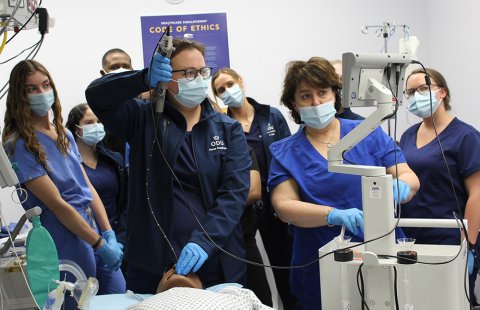
Working with equipment in high-tech facilities helps our students get ahead. The Human Anatomy Lab, Immersive and Simulation Lab and Center for Applied Surgical Technique include:
- A plastination lab
- An ultrasound lab
- Gross and fresh cadaver labs
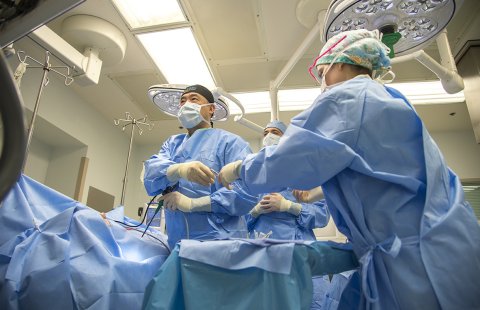
- Mock operating rooms
- Computerized trainers
- A surgical skills lab
Our surgical assisting students participate in a leadership certificate program and graduate with skills that can serve them in medical education, surgical services management and professional leadership settings.
First-year students organize and conduct Suture Fest and help medical students prepare for surgical training exposure.
Our graduates enter the workforce with the same level of experience as junior surgical residents. Surgical assisting students learn the fundamentals of laparoscopic surgery, the same coursework required of surgical residents. The school requires students to complete 240 cases — 100 more than the number required by the accreditation body — but many students complete more than three times the required number of cases.
Graduates from our program have the equivalent surgical competency and clinical knowledge expected of a junior surgical resident.

Clinical Placements
Manages and assigns students’ clinical placements. Students complete eight clinical rotations in their 12-month clinical training, at sites including:
- Level 1 trauma facilities
- Contract surgical service companies
- Surgical centers, both private and outpatient
- Hospitals and medical centers
- Clinical facilities
- Private practices
Who are our students?
Our students are highly motivated problem solvers, who possess the capacity and critical thinking skills needed to handle high-stress situations and be strong leaders in an operating room setting. Hear alumna Kenita Jackson's story.
Additional Information
The Surgical Assisting (M.S.A.) program is the nation's only master's-level surgical assisting program delivered in the traditional surgical residency training model. Contact us by email or by phone (757.446.6165) for your staffing needs.
Hiring a Surgical Assisting (M.S.A.) graduate can:
- increase the satisfaction of your surgeons
- increase your patient volume
- reduce operating room (OR) turnover times
- increase your annual revenue
- maximize OR productivity
- add a highly educated and trained member to your OR team
- increase your internal pool of management candidates
The Surgical Assisting (M.S.A.) program has been setting the national standard for surgical assistant training since 1981. Surgical assisting graduates:
- complete the same anatomy and pathophysiology curriculum as medical students
- receive the same laparoscopic surgical skills training as surgical residents
- complete a curriculum focused on human anatomy and applied surgical techniques
- complete 12 months of clinical training in Level 1 trauma facilities, outpatient surgical centers and private surgical centers
- have clinical experiences across a variety of surgical specialties
- are trained in robot-assisted surgical procedures
- have management training in surgical services
- sit for the only national certification for surgical assistants created by surgeons, the Certified Surgical Assistant (CSA) Exam
Purpose of Professional Licensure Statement
This institute delivers online education programs and courses throughout the United States and internationally. All programs have been approved by the Board of Visitors. The U.S. Department of Education and the National Council for State Authorization Reciprocity Agreements (NC-SARA) are agencies that oversee the integrity of distance education.
In accordance with U.S. Department of Education and NC-SARA requirements, Macon and Joan Brock Virginia Health Sciences at Old Dominion University must provide all potential students with the following disclosure(s):
Professional Licensure Disclosure
The institute does meet the requirements for licensure in the state of Virginia. The legislation (18VAC85_160-50) was passed in July 2020 requiring licensure of all surgical assistants in the state of Virginia. Requirements for professional licensure can vary by state and can change without notice. All prospective students should consult the state licensing body in the state in which they reside or seek to be licensed to ensure that the degree they earn will meet the requirements for licensure in that state.
The institute is available to discuss with students or prospective students their respective or prospective degree options. Please contact us at 757-446-6165.
Faculty

Staff
The Bureau of Labor Statistics has recognized a separate definition for Surgical Assistants starting in 2018.
The National Surgical Assistant Association announced in late 2017 that the BLS' Standard Occupational Classification Committee added Surgical Assistant to its list of nationally recognized professions.
According to the SOC Committee's manual, federal agencies collect, calculate, analyze and disseminate data about the occupations included in the SOC system. The classification of surgical assistants in this system should allow for more comparable data to be collected about the profession.
The BLS' decision could also open the door for surgical assistants who are private contractors to request direct billing of services.
Below is the approved BLS definition, effective Jan. 1, 2018:
29-9093 Surgical Assistants
"Assist in operations, under the supervision of surgeons. May, in accordance with State laws, help surgeons to make incisions and close surgical sites, manipulate or remove tissues, implant surgical devices or drains, suction the surgical site, place catheters, clamp or cauterize vessels or tissue, and apply dressings to surgical site. Excludes 'Registered Nurses' (29-1141) and 'Surgical Technologists' (29-2055)."
Next Steps
Join the rapidly growing field of surgical assisting with a degree from the only master's level Surgical Assisting program of its kind in the country.
