
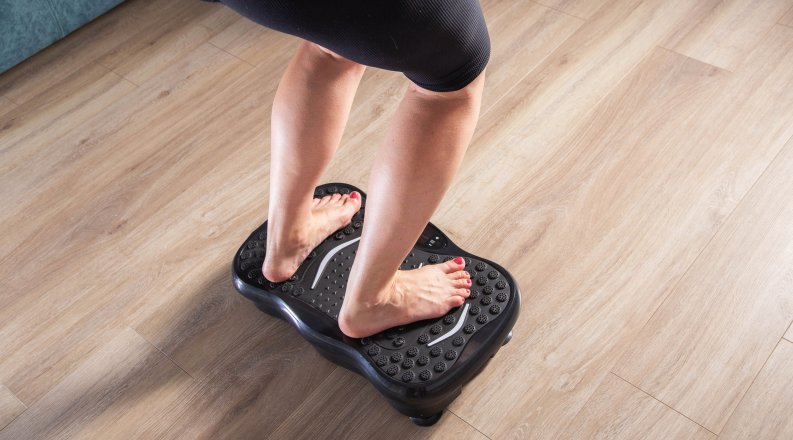


If you’ve spent any time on social media lately, you’ve probably seen them: sleek platforms gently shaking beneath people as they stand, squat, stretch, or even just scroll on their phones. Vibration plate machines, also known as whole-body vibration platforms, have surged in popularity, fueled by viral videos and bold claims promising everything from faster weight loss to improved circulation and muscle tone with minimal effort.
As these machines start appearing in gyms, wellness studios, and home workout spaces, many consumers are left wondering whether vibration plates are a legitimate health tool or simply the latest fitness fad. The answer, as it turns out, lies somewhere in between.
“Vibration plate machines work by sending rapid vibrations through the body while a person stands or exercises on the platform,” said John Snellings, MD, professor and chair of Family & Community Medicine at Macon & Joan Brock Virginia Health Sciences EVMS Medical Group at Old Dominion University. “These vibrations cause muscles to contract and relax repeatedly in an attempt to stabilize the body.”
Advocates suggest that this increased muscle activation can amplify the effects of simple movements, making short workouts more effective. “Research suggests that performing exercises on a vibrating surface could possibly activate muscles more than doing the same movements on solid ground,” said Dr. Snellings. “This may help improve muscle strength over time, particularly when vibration training is combined with traditional strength exercises.”
Balance and stability may also improve with vibration training. Because the vibrations create an unstable surface, the body recruits core and stabilizing muscles to maintain posture.
Another frequently discussed benefit is circulation. Many vibration plate products claim to temporarily increase blood flow, which is why some people use vibration plates as part of a warm-up or recovery routine.
Despite these potential benefits, many of the more dramatic claims circulating online are not strongly supported by science. Weight loss is a prime example. “While standing on a vibration plate may burn slightly more calories than standing still, the increase is relatively small,” said Dr. Snellings. He adds that vibration training alone is unlikely to lead to meaningful fat loss without traditional exercise and dietary changes. “Vibration plates are not a shortcut to weight loss, no matter how effortless they may look on social media.”
Another limitation is the lack of long-term research. Many studies on whole-body vibration are short in duration or involve small sample sizes, making it difficult to draw firm conclusions about lasting health benefits. This doesn’t mean vibration plates are ineffective, but it does suggest they should be used with realistic expectations.
Safety is another important consideration. Dr. Snellings suggests vibration plates are not appropriate for everyone. People who are pregnant, have heart conditions, blood clots, joint replacements, pacemakers, severe osteoporosis, balance disorders, or recent injuries should consult a healthcare provider before using one. Even for healthy individuals, improper use or excessively high vibration settings can increase the risk of muscle strain, joint stress, or discomfort.
For those who choose to try vibration plates, experts recommend approaching them as a supplement rather than a substitute for regular physical activity. Starting with low intensity and short sessions allows the body to adapt to the vibrations. Proper posture and form are essential, just as they are with any exercise equipment. When used thoughtfully and in moderation, vibration plates may offer added variety and engagement to an existing fitness routine.
The current popularity of vibration plate machines reflects a broader trend in wellness culture: the desire for efficient, accessible tools that fit into busy lifestyles. While vibration plates are not miracle devices, they are not pure hype either. They may offer benefits related to muscle activation, balance, and recovery, particularly when paired with conventional exercise. “The key is understanding their limitations,” said Dr. Snellings, “and using them safely.”

PO Box 1980
VA 23501