About this Program
Old Dominion University offers a Master of Surgical Assisting. Our 71-credit-hour program includes 36 credits of training in our 10-month didactic phase and 35 credits of clinical practice in the second year.
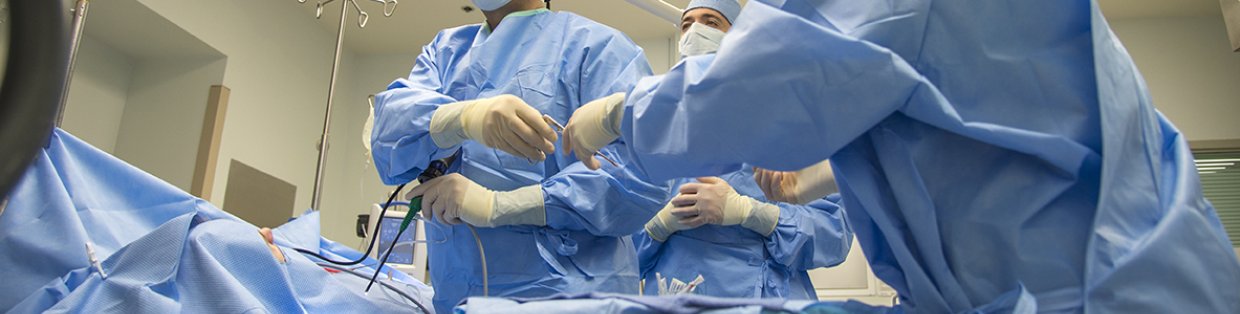
Our immersive experience allows for direct observation and active participation with the surgical team to develop the critical clinical skills surgical assistants need. Students are exposed to surgical services, including perioperative, intraoperative and postoperative patient care, and ancillary surgical services, such as central sterile services and pathology.
This training complements the hands-on instruction students receive in the surgical environment. Our students enter the clinical phase of the program with practical experience in the operating room and a strong foundation of surgical knowledge. Visit the department website for additional program info ▶
Program Highlights
-
100% pass rate: For more than 20 years, our students have achieved a 100% pass rate on certification exams.
-
100% job placement: All Surgical Assisting students have job offers prior to graduation.
-
3 times more cases: Our average student completes more than three times the number of cases required by the accreditation body.
Careers
Surgical Assistants are designated as a Bright Outlook occupation by the U.S. Department of Labor's O*NET program—federal recognition of exceptional career prospects and workforce demand.
What is Bright Outlook?
O*NET Bright Outlook occupations meet at least one of the following criteria:
Projected to grow faster than average (5% or more employment growth) over 2024-
2034- Projected to have 75,000 or more job openings nationwide over 2024-2034
- New and emerging occupations
Surgical Assistants qualify for Bright Outlook designation through:
- 5% projected growth rate (exceeds the national average of 3%)
- Federal recognition as a distinct profession by the Bureau of Labor Statistics (effective
- Critical workforce shortage with 33% supply shortfall nationally
This federal designation indicates strong labor market demand, career stability, priority status for workforce development funding, and represents a recommended career pathway for students and career changers.
Bureau of Labor Statistics 2024-2034 Projections:
|
Employment Metric |
Data |
|---|---|
| Projected Growth Rate | 5% (2024-2034) vs. 3% national average |
| Annual Job Openings | 8,700 positions nationally |
| Current Employment | 25,300 surgical assistants |
| Active Job Openings | 28,000 positions |
| Currently Filled Positions | 18,780 surgical assistants |
| Supply Shortage | 9,220 unfilled positions (33% shortfall) |
| Median Annual Wage | $60,290 (May 2024 BLS) |
| Entry-Level Salary Range | $65,000 - $80,000 |
| Salary Growth Trend | 7% annual growth over past 5 years |
| Top Earners (90th percentile) | $102,390 |
Primary Employment Sectors:
- Hospital OR Teams (60%): Academic medical centers, community hospitals, specialty surgical centers
- Private Staffing Companies (40%): Travel SA positions, locum tenens, flexible contract work
- Leadership & Management (20%): OR directors, surgical services coordinators, independent contractors
Specialization Opportunities:
- Cardiovascular surgery
- Orthopedic surgery
- Neurosurgery
- General surgery
- Pediatric surgery
- Robotic surgery specialization
- Trauma surgery
- Transplant surgery
Geographic Opportunities:
- Highest Employment States: Texas (2,000), Georgia (1,390), Illinois (1,120), Tennessee (1,060), Florida (1,050)
- Highest Paying States: Minnesota ($104,420), Maryland ($92,810), Colorado ($90,640)
- Best Markets: District of Columbia, Florida, Alaska, Iowa, New Hampshire have highest employment density
- National Placement: Graduates employed nationwide with opportunities in all 50 states
Career Advancement:
- 20% of graduates advance to leadership roles within 5 years
- OR management and surgical services coordination
- Clinical education and program director positions
- Independent practice and surgical consulting
Why EVMS/ODU Graduates Are in Demand
Superior Clinical Training:
- High-volume surgical experience: 3× the minimum case requirements
- Diverse case exposure: All surgical specialties and complex procedures
- National clinical sites: Mayo Clinic, Rush, Michigan, DC-area academic centers
- Academic medical center focus: Highest acuity cases, teaching environment
Advanced Credentials:
- Master's degree: Only graduate-level training nationally
- Robotic surgery certified: da Vinci system training (exclusive)
- Laparoscopic fundamentals: Surgical resident-level curriculum
- Leadership prepared: OR management certification included
Proven Outcomes:
- 90% receive job offers before graduation
- Starting salaries at top of national range
- 100% certification pass rate for 20+ years
- Strong employer relationships nationwide
- Career longevity and advancement success
Surgical Assistants are designated as a Bright Outlook occupation by the U.S. Department of Labor's O*NET program—federal recognition of exceptional career prospects and workforce demand.
What is Bright Outlook?
O*NET Bright Outlook occupations meet at least one of the following criteria:
Projected to grow faster than average (5% or more employment growth) over 2024-
2034- Projected to have 75,000 or more job openings nationwide over 2024-2034
- New and emerging occupations
Surgical Assistants qualify for Bright Outlook designation through:
- 5% projected growth rate (exceeds the national average of 3%)
- Federal recognition as a distinct profession by the Bureau of Labor Statistics (effective
- Critical workforce shortage with 33% supply shortfall nationally
This federal designation indicates strong labor market demand, career stability, priority status for workforce development funding, and represents a recommended career pathway for students and career changers.
Bureau of Labor Statistics 2024-2034 Projections:
|
Employment Metric |
Data |
|---|---|
| Projected Growth Rate | 5% (2024-2034) vs. 3% national average |
| Annual Job Openings | 8,700 positions nationally |
| Current Employment | 25,300 surgical assistants |
| Active Job Openings | 28,000 positions |
| Currently Filled Positions | 18,780 surgical assistants |
| Supply Shortage | 9,220 unfilled positions (33% shortfall) |
| Median Annual Wage | $60,290 (May 2024 BLS) |
| Entry-Level Salary Range | $65,000 - $80,000 |
| Salary Growth Trend | 7% annual growth over past 5 years |
| Top Earners (90th percentile) | $102,390 |
Primary Employment Sectors:
- Hospital OR Teams (60%): Academic medical centers, community hospitals, specialty surgical centers
- Private Staffing Companies (40%): Travel SA positions, locum tenens, flexible contract work
- Leadership & Management (20%): OR directors, surgical services coordinators, independent contractors
Specialization Opportunities:
- Cardiovascular surgery
- Orthopedic surgery
- Neurosurgery
- General surgery
- Pediatric surgery
- Robotic surgery specialization
- Trauma surgery
- Transplant surgery
Geographic Opportunities:
- Highest Employment States: Texas (2,000), Georgia (1,390), Illinois (1,120), Tennessee (1,060), Florida (1,050)
- Highest Paying States: Minnesota ($104,420), Maryland ($92,810), Colorado ($90,640)
- Best Markets: District of Columbia, Florida, Alaska, Iowa, New Hampshire have highest employment density
- National Placement: Graduates employed nationwide with opportunities in all 50 states
Career Advancement:
- 20% of graduates advance to leadership roles within 5 years
- OR management and surgical services coordination
- Clinical education and program director positions
- Independent practice and surgical consulting
Why EVMS/ODU Graduates Are in Demand
Superior Clinical Training:
- High-volume surgical experience: 3× the minimum case requirements
- Diverse case exposure: All surgical specialties and complex procedures
- National clinical sites: Mayo Clinic, Rush, Michigan, DC-area academic centers
- Academic medical center focus: Highest acuity cases, teaching environment
Advanced Credentials:
- Master's degree: Only graduate-level training nationally
- Robotic surgery certified: da Vinci system training (exclusive)
- Laparoscopic fundamentals: Surgical resident-level curriculum
- Leadership prepared: OR management certification included
Proven Outcomes:
- 90% receive job offers before graduation
- Starting salaries at top of national range
- 100% certification pass rate for 20+ years
- Strong employer relationships nationwide
- Career longevity and advancement success
Featured Courses
Requirements
Candidates must have completed all undergraduate degree requirements and have been issued a bachelor’s degree prior to matriculating as an VHS student. If the bachelor’s degree was issued by a U.S. college or university, as a general rule it should be from a regionally accredited institution. However, the program may grant exceptions on a case-by-case basis.
Official transcripts from the awarding institution must specify the date upon which the degree was issued. All individuals must satisfy the admission requirements. Currently the program does not accept international students or medical graduates.
Applications will be accepted between October 1 and May 31
-
be a U.S. citizen or have proof of permanent residency status. Applicants born outside the U.S. must provide proof of U.S. citizenship or permanent residency status upon agreeing to accept a student position at VHS.
-
have a baccalaureate degree (in any area of study) and a qualifying grade point average of 3.0 (B) or better.
-
have completed the following prerequisite courses with a grade of B- or higher within the last 10 years:
- Anatomy and Physiology I and II with lab (human anatomy/physiology recommended): 6-8 credit hours
- General Biology with lab {an equivalent or a higher-level course in this subject matter}: 3 credit hours
- General or Intro Chemistry with lab {an equivalent or a higher-level course in this subject matter}: 3 credit hours
- Microbiology with lab: 3 credit hours
**Completion of no more than two online prerequisites in Chemistry, Biology, and/or Microbiology.
**Waivers for online Anatomy and Physiology courses are subject to approval by the program.
-
submit two (2) evaluations of recommendation
-
submit a personal statement
Cost of Attendance
We believe in providing students with transparent and accessible information about the cost of attendance.
Review the estimated tuition rates current academic year (subject to change). Other fees are assessed for special services and certain academic programs. Non-resident rates are charged for anyone who is not a current Virginia resident, including international students.
You may benefit from the Academic Common Market (ACM) and In-State Tuition Eligibility, accessing Virginia in-state tuition prices at ODU.
Are you a resident of Alabama, Arkansas, Delaware, Florida, Georgia, Kentucky, Louisiana, Maryland, Mississippi, Oklahoma, South Carolina, Tennessee, Texas or West Virginia?
Eligibility & Application Process:
- Confirm eligibility through the Southern Regional Board of Education’s ACM.
- Contact your state coordinator.
- Complete the state application.
- Receive certification for in-state rates.
For additional information about the Academic Common Market, please visit the Southern Regional Education Board ACM website or contact the program directly.