

Written By: Tiffany Whitfield
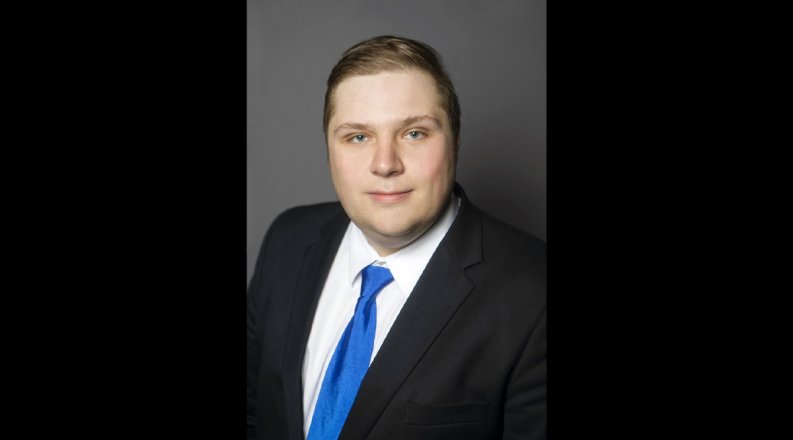
Associate Professor Michael Pokojovy, Ph.D., holds two appointments at Old Dominion University. He teaches and conducts research in the Department of Mathematics and Statistics, where he additionally serves as graduate program director, and he’s also a statistics fellow in the School of Data Science. Over his time in academia, he has seen data mining and machine learning setting the foundation of modern data science. Dr. Pokojovy encourages anyone who has an interest in mathematics, statistics or data science to consider coming to ODU to pursue a higher education degree.
Prior to joining ODU in 2023, Dr. Pokojovy completed his undergraduate and graduate studies in mathematics and statistics, along with a minor in computer science, at the University of Konstanz located on the picturesque Lake Constance in Baden-Württemberg, Germany, on the very border with Switzerland. After leaving Europe, his first tenure-track position in the United States was at the University of Texas at El Paso in the Department of Mathematical Sciences.
At ODU, Dr. Pokojovy leverages data-oriented methodologies in teaching, research and interdisciplinary collaborations. “I’m doing a lot of work at the methodological level at ODU. We have developed theoretical foundations of various machine-learning techniques along with computational algorithms,” said Dr. Pokojovy. “In mathematics and statistics, as a student, you get the training where you learn the theoretical foundations, you get the programming experience, you work on projects that typically involve real data and real-world problems, so that, that gives you an edge,” said Dr. Pokojovy. Multiple programs in mathematics and statistics are available to serve a variety of students from undergraduates to master’s and Ph.D. students. “In our programs, the student-faculty ratio is fairly low, and we have lots of talented faculty,” said Dr. Pokojovy.
He believes ODU is “a very good place to be,” especially if you are seriously interested in working with data. “Being a data-driven person really helps immensely because basically, it's one of those skills that helps you in any field of study,” said Dr. Pokojovy. “Here at Old Dominion University, we have various subfields of data science being housed in different departments.” In the College of Sciences, you’ll find Mathematics & Statistics and Computer Science. With the launch of the new School of Data Science in 2023, now there is a Center that unites people across departments and colleges. “If you want to get involved, I encourage you to start attending seminars that take place almost every week at the School of Data Science and to reach out to faculty as well,” said Dr. Pokojovy.
Since he’s been in this field, he has seen the evolution of data science. “There were still, so to speak, early days of data mining and machine learning on university campuses when I got into the field,” said Dr. Pokojovy. “Nowadays data science transcends science, so it's not necessarily that you address scientific questions, but I would say a data scientist generally operates based on scientific method,” said Dr. Pokojovy. “It’s so easy to collaborate with people from other colleges, because you have the shared language, you can help people that have data and have a question to answer, so this makes it very interesting and specific.”
At ODU, he collaborates with Drs. Stevenson and Zhang from the Department of Finance and E.V. Williams Center for Real Estate, Dr. Song from the Department of Mathematics and Statistics, and Dr. Reynolds from ODU’s School of Exercise. He also does research with academic institutions around the U.S., including Georgetown University, the University of Connecticut, University of Memphis, University of Nebraska Medical Center, University of Texas at El Paso and University of Texas Medical Branch, etc.
Data can be collaborative. “You can contribute to many different fields without necessarily being an expert in any of those fields which gives you sometimes a big advantage, because you're never tied to just one area, so you can always maneuver a bit,” said Dr. Pokojovy. He believes those who use data can follow their interests, or follow the trend, or find their niche in the areas where they can make the biggest impact.
There are many practical aspects to data science. “Data could be about theory and algorithms, or about software, it could be about physical infrastructure, cloud computing, high-performance computing, and so on,” said Dr. Pokojovy.
His advice to prospective and current ODU students is that “you can work with experienced researchers and professionals,” and so on. “There is work for everyone, in different departments and for people with different backgrounds,” said Dr. Pokojovy.
Dr. Pokojovy brings into view the four paradigms of science that have helped lay out a foundation for modern science but with mathematics as the bedrock. According to Dr. Pokojovy, the first “probably started with the observational approach to the world in Ancient Egypt.” The second paradigm comes from the period based on “equations and models, with calculus and differential equations.” The third was the computational paradigm, “when we had the computing to run simulations, but we still had a shortage of data, so we still had to rely on theoretical models.” Dr. Pokojovy believes, “the fourth paradigm is a data-driven paradigm when you have the luxury of having the data that can supplement and enhance your theories.” He believes all four paradigms coexist nowadays. “The data-driven paradigm takes us back to the very first empirical paradigm in some sense; but nowadays the reason why it all works is that we have very solid theoretical foundations,” said Dr. Pokojovy. “We have the computational power, and the data, and the talent and now we live in the right time where we can benefit from this synergy of the scientific development over the centuries.”