
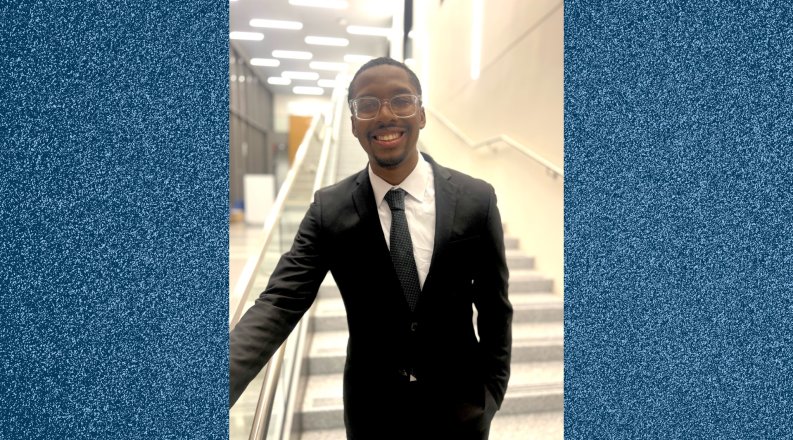


Old Dominion University student Miles Salley experienced a data revelation in Durham, N.C., this summer.
The 21-year-old senior political science major from Chesterfield attended the 2025 American Political Science Association Ralph Bunche Summer Program at Duke University. He was among a handful of APSA scholars chosen from across the nation. Under the direction of Dr. Paula D. McClain, the program is designed to introduce aspiring political scientists to the world of doctoral study.
“It was very intensive,” said Salley, looking back on the five-week program. “It was very fast-paced and it definitely made you appreciate what political scientists do in the field when it comes to research.”
For example, he learned the finer points of “R” a free, open-source programming language and software environment that researchers use for crunching statistics and analyzing data.
“Just seeing what political scientists do and understanding that it’s more than just reading books and spouting different theoretical perspectives,” Salley said. “It’s genuinely scientific — applying scientific methods to political questions, political theories, political behavior.”
He came away with a deeper appreciation of his major.
“It definitely made me want to pursue becoming a professor, a researcher,” Salley said.
The Old Dominion professor who recommended Salley for the program described it as a potentially valuable stepping stone. “Developing these tools gives students a skill set that they will take with them when they begin their graduate studies,” wrote Athena King, “and ensures that they will have a good chance of seeing their Ph.D. programs through to fruition.”
Salley said learning to write code was a key takeaway from the program at Duke.
“I really had no idea that political scientists actually code,” he said. “That, to me, was a little bit shocking when on my first day I got into a lab and they were like, ‘Oh, we're going to use this coding website …’”
Once the shock wore off, he was impressed with the complexity and power of the platform and the programming it supported. “It was just really cool using that website to derive our data, and coding to clean up data that we were using for our projects and our papers.”
Salley’s own research project explored a topic close to home. He looked at political participation among citizens who attend Black churches.
“I am very interested in political psychology, political behavior, political socialization … and public policy,” he said. “And as a social institution, we understand the Black church to be a pillar in Black communities for decades ... And what I basically wanted to examine was whether or not when you have a decrease in participation among Black people in the church, will you see a decrease in political participation.”
Raw data for his research came from the Collaborative Multiracial Post-Election Survey or CMPS. The survey’s website describes it as a “non-partisan, multiracial/ethnic, multilingual, post-Presidential election online survey in the United States, developed by academic researchers in 2008.”
The survey is built with help from a national CMPS Scholars Research Network that includes 250 researchers from nearly 100 colleges and universities.
Salley said his experience in Durham also connected him with a tight-knit group of like-minded students. His cohort worked well together, he said. “We genuinely tried to help one another out in areas we didn't understand. I thought that was very, very, very beneficial.”
And they remain in touch.
“I just texted them — literally — today,” Salley said.