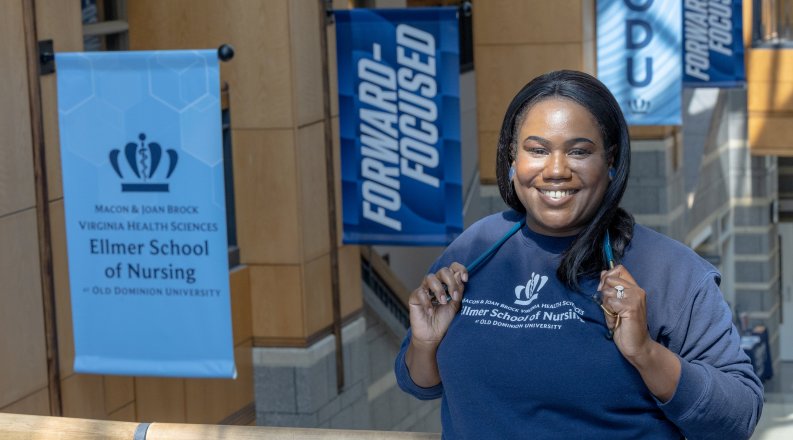


Growing up in the rural town of South Boston, Virginia, Leslie Okhirkhian, B.S.N. Class of 2026, saw firsthand the effects of health inequities and limited access to healthcare.
These early experiences stayed with her, even as she began her initial career in hospitality.
In 2020, as the COVID-19 pandemic disrupted the hospitality industry and exposed deep gaps in healthcare, Leslie found herself wanting to pursue a career that was not only recession-proof, but also one where she could serve her community, family and friends.
“I was laid off, and at the same time, people close to me were getting very sick,” Leslie said. “I wanted to do something that would allow me to help in a real, tangible way.”
Nursing offered a way to care for others, while addressing the very challenges she had witnessed growing up.
Leslie enrolled in the Bachelor of Science in Nursing (B.S.N.) program at Macon & Joan Brock Virginia Health Sciences Ellmer School of Nursing at Old Dominion University, where she quickly distinguished herself, not only for her academic performance, but for her curiosity and drive to go deeper.
“Leslie has been an exceptional student from the very beginning of her first semester coursework,” said Amy Yarock-Meeker, M.S.N., RN, lecturer at Ellmer School of Nursing at Old Dominion University. “She consistently demonstrated a desire to delve deeper into the material, often going beyond what was expected. Her curiosity, initiative and commitment to fully understanding each concept set her apart early on.”
“I truly believe that I have stepped into a calling and a purpose to be of service to the people I care about the most,” Leslie shared.
Balancing nursing school required more than academic focus. It demanded discipline and a strict schedule. As a mother of a 4-year-old, Leslie built her schedule around her studies and quality family time.
Her days often began at 3 a.m., when she would wake up to study before getting her daughter ready for daycare and heading to class. Between lectures, she used every available moment to review material, ensuring that evenings could be reserved for her family.
“It was a very structured routine,” she said. “I wanted to make sure I could be present for my daughter, while still doing my best in school.”
Her weeks were packed. On weekdays, she juggled classes, assignments and research projects, while Sundays were spent on 12-hour clinical shifts. Still, she made sure Saturdays were strictly mommy-and-daughter days.
“That’s our day,” she said. “No school, no work, just time with my daughter.”
Even with a full schedule, Leslie found ways to support others. Through the Student Nurses Association, she and her peers organized study sessions for fellow students to help them prepare for exams.
“I had just gone through the same material, and I understood where people were getting stuck,” she said. “It became a way for all of us to learn together.”
Her commitment to service extended beyond the classroom. In Franklin, Virginia, Leslie’s community health work inspired her nursing honors project. Partnering with one of ODU Community Care’s clinics in the area, she conducted blood pressure screenings over several weeks, tracked participants’ vital signs and provided education on hypertension.
Over time, she observed improvements in participants’ blood pressure readings, reinforcing the impact of consistent access and education.
Her second honors project focused on critical care, where she developed a decision-support tool to help nurses manage continuous renal replacement therapy, a complex treatment used in intensive care units.
“I noticed that even experienced nurses felt overwhelmed by this process,” she said. “I wanted to create something that could support them and help reduce that burden.”
The reference tool is now being considered for broader use, reflecting Leslie’s ability to translate learning into practical solutions.
After graduation, she will begin her career in a cardiovascular intensive care unit, a setting that aligns with her passion for high-acuity care. But, for Leslie, the technical side of nursing is only part of the story.
She believes the true impact of nursing is in recognizing the person behind the patient.
“It’s easy to focus on the diagnosis,” she said. “But, there’s a human being experiencing it.”
As she prepares to step into her career, she shares one piece of advice to her peers and future nurses.
“Never forget your why,” she said. “When things get really hard, remembering why you’re doing this in the first place is very grounding.”

PO Box 1980
VA 23501