
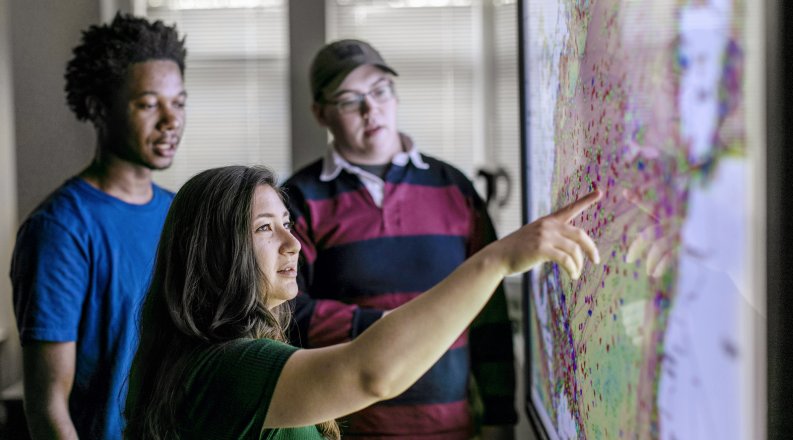


Old Dominion University is charting a course toward innovation with Splice Technologies, Inc. (Splice) to enhance student opportunities and tackle global supply chain challenges. A new partnership between the University and Splice will allow students to dive deep into datasets focused on seaport and port terminal operations.
Kevin Speers, CEO and co-founder of Norfolk-based Splice, a business-to-business software company that uses systems integration and artificial intelligence (AI) to automate logistics processes, said the partnership will open new doors to innovative solutions and optimize supply chains worldwide.
“We’re excited about the collaboration with Old Dominion University. It’s a great opportunity to support the students and faculty by sharing our capabilities in logistics workflow automation and integration,” Speers said. “Our platform brings together the many translators and connectors to create more efficient processes, and we are looking forward to seeing how students and professors can use our platform to bring out their ingenuity and uncover new ways to make global supply chains more efficient."
A Memorandum of Understanding was recently signed between Splice and Old Dominion University’s School of Supply Chain, Logistics and Maritime Operations and its Maritime, Ports and Logistics Institute (MAPLI). It will provide real-world data about ocean carriers, ports and terminals, and transportation, yard and warehouse management systems to solve current supply chain problems.
Elspeth McMahon, Ph.D., associate vice president for maritime initiatives at Old Dominion University, said the partnership will strengthen collaboration on research, education and knowledge-sharing in seaport and port terminal operations. For example, supply chain and maritime operations students and faculty will have the opportunity to develop research projects and co-author publications related to increasing port and supply chain efficiency.
“Through this partnership, we are giving our students and faculty the opportunity to gain hands-on experience and tackle real-world challenges. At the same time, we’re generating insights that can help make U.S. ports more efficient while preparing the next generation of maritime professionals for the challenges ahead,” McMahon said.
Ricardo Ungo, Ph.D., a clinical assistant professor in the School of Supply Chain, Logistics and Maritime Operations and the director of MAPLI, will use Splice’s datasets to create case studies for classes like Supply Chain 4.0: Technologies and Innovations. The class analyses the role of technology in the supply chain by studying digitalization and data integration, connectivity, AI blockchain, large language models, automation and robotics and anti-hacking technologies.
"This collaboration with Splice will open possibilities for the creation of educational materials and case studies related to port and shipping performance. Our students will benefit from the opportunity to use the materials and resources for course work and final projects,” Dr. Ungo said. “Through this analysis, students will also get a hands-on, deeper understanding of how to make the logistics processes more efficient and effective.”
Partnerships such as this are integral to how Old Dominion University’s School of Supply Chain, Logistics and Maritime Operations provides practical, real-world learning experiences to students. The school actively supports Virginia’s blue economy through interdisciplinary education, diverse programs from micro-credentials to graduate degrees, and fostering workforce development.