


By David Simpson
Sometimes, it’s good to pause and reflect. Consider the ground under our feet – who once walked here, lived here, thrived here?
Before English settlers arrived in eastern Virginia in 1607, it was native peoples: Chesapeakes, Nansemonds and other Algonquian-speaking groups within the Powhatan paramount chiefdom, Tsenacomoco.
In this spirit, a Nov. 10 symposium at Old Dominion University will explore the concept of native land acknowledgement – a formal statement that recognizes indigenous peoples as traditional stewards of the land. Titled “This Is Tsenacomoco," the event takes place from 11 a.m. to 3:30 p.m. in the Big Blue Room of Chartway Arena. Lunch will be served, and the public is invited to attend. You must register by Nov. 4.
“This is something I’ve been hoping to organize for a long time,” said Drew Lopenzina, a professor of English at ODU and a scholar of Native American and indigenous studies.
Native land acknowledgements are typically read aloud at some public functions, posted on an institution’s website and sometimes attached to emails or printed publications.
“All of our peer institutions across Virginia have developed an official land acknowledgement statement, and ODU has not,” Lopenzina said. “So I thought it was imperative that we embrace this gesture and develop a statement, and the idea is that we would do it in conversation with the indigenous stakeholders.”
There will be a morning session, a lunch session and an afternoon session. Besides Lopenzina, participants include:
- Chief Keith Anderson, Nansemond Indian Nation
- Nikki Bass, tribal historian, Nansemond Indian Nation
- Kara Canaday, chief executive officer of the Virginia Tribal Education Consortium (VTEC), citizen of the Chickahominy Tribe and ODU graduate
- Hailey Holmes, VTEC project director, citizen of the Chickahominy Tribe and ODU graduate
- Lauren Eichler, lecturer, Department of Philosophy and Religious Studies at ODU
- Kole Matheson, lecturer, Department of English at ODU
- Andy Fisher, associate professor, Harrison Ruffin Tyler Department of History at the College of William & Mary
- Laura Delbrugge, dean, College of Arts and Letters at ODU
- Leonard Brown, vice president for student affairs, Norfolk State University
- Faith Fitzgerald, assistant vice president for campus life and diversity, NSU
- September Sanderlin, vice president for human resources, diversity, equity and inclusion at ODU
Lopenzina said he hopes the group will draft a statement by day’s end.
“The whole thing, it’s a conversation,” he said. “What I’m hoping is it’s going to be a really vibrant conversation about not just land acknowledgement and what that means, but also what happens after the land acknowledgement.”
That could mean a bridge program to help high schoolers from the tribes get ready for the first year of college, he said. It could mean thinking about how to tell a more authentic public history in Virginia, both in our schools and on our tourism signs.
Lopenzina said attendees will be surprised at the presentation by native communities and how invested they are in retaining their cultural identities.
“We don’t really very often get to hear indigenous people in the community speaking about what it is that they need and what they think and how they understand our history and how they think the future should look,” he said. “I think this will allow people to imagine that there is a really positive path forward for these types of issues.”
The event is sponsored by the Office of Institutional Equity and Diversity, the College of Arts and Letters and the Department of English at ODU and the Office of Campus Life and Diversity at Norfolk State University, in partnership with the Virginia Tribal Education Consortium and Nansemond Indian Nation.
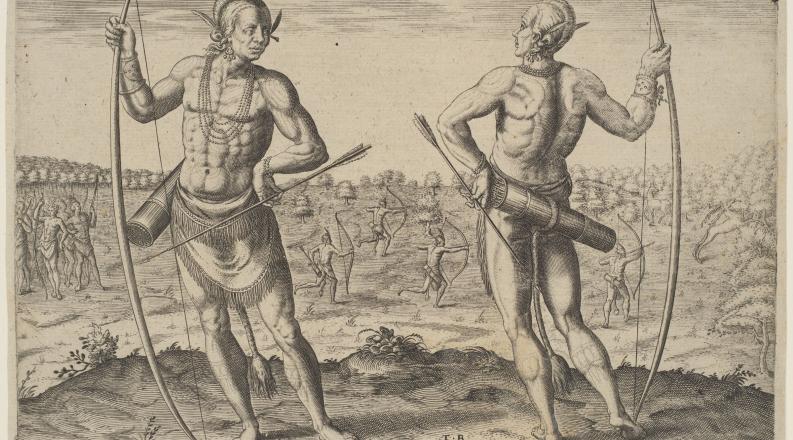
Image: “A Weroan or Great Lord of Virginia,” engraving by Theodor de Bry after John White (Harvard Art Museums/Fogg Museum, Gift of William Gray from the collection of Francis Calley Gray; used by permission)