
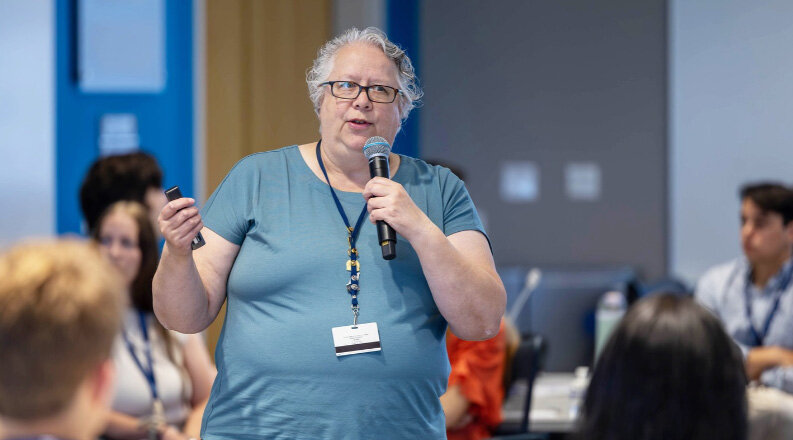


Julie Kerry, Ph.D., is one of only four educators nationwide selected to receive the 2026 Alpha Omega Alpha Robert J. Glaser Distinguished Teacher Award, presented as part of the Association of American Medical Colleges (AAMC) Presidential Awards. The national recognition honors her contributions to medical education and her efforts to help future physicians build the knowledge, skills and confidence they need to care for patients.
An accomplished molecular biologist who spent 16 years leading National Institutes of Health-funded research, Dr. Kerry has brought the same scientific discipline that defined her research career to the classroom.
In her current role as the EVMS Foundation Distinguished Professor in Biomedical Sciences and vice chair and professor of biomedical and translational sciences at Macon & Joan Brock Virginia Health Sciences Eastern Virginia Medical School at Old Dominion University, Dr. Kerry has helped develop innovative approaches to medical education, from programs that support students transitioning into medical school to initiatives that strengthen foundational learning and reshape the curriculum.
“Dr. Kerry’s selection for the Robert J. Glaser Distinguished Teacher Award is a tremendous recognition of the impact she has had on medical education and on the students she serves,” said Judette Louis, MD, M.P.H., dean of Eastern Virginia Medical School at Old Dominion University. “Her ability to bring the rigor and discipline of a scientist to the work of educating future physicians has helped her develop innovative and adaptive approaches that strengthen student learning. This achievement reflects both Dr. Kerry’s extraordinary contributions and the caliber of educators who are shaping the future of medicine and science education at this institution.”
One of Dr. Kerry’s most significant contributions is the Proficiency Enhancement Program (PEP), an optional program that provides additional academic support to medical students during the first year of medical school.
Dr. Kerry's interest in strengthening foundational knowledge among preclerkship learners began in 2016 when she attended the Harvard Macy Institute Program for Educators in Health Professions. There, she led the development of an intervention program designed to help medical students seeking additional academic support. That initiative has since evolved into PEP, which runs parallel to the first-year curriculum.
What began with just four students in 2016 has grown substantially. In 2025, more than 80% of the MD cohort participated in the program.
Dr. Kerry directs PEP, working alongside three faculty mentors who lead weekly sessions in a collaborative, small-group setting. Rather than simply reviewing course material, students are encouraged to actively engage with concepts, think critically and work through challenging scientific and clinical questions together.
Creating an environment where students feel comfortable taking intellectual risks is central to the program's approach.
“One of the most important components of PEP is creating a space where students are willing to be wrong, but also open to learn, and I think this has been a key to its success,” Dr. Kerry said. “Working with students in this way has shown me how eager they are to learn and become the best physicians that they can be, but also, the sessions are fun. It is rare that we get to work with small groups of students and brainstorm about science and clinical knowledge.”
For Dr. Kerry, understanding how students learn is just as important as understanding the subject matter itself.
“A key part of research is looking at data and evidence and building from there,” she said. “In education, I try to take the same approach — what do we know about how learners acquire and use knowledge and how can I apply that in the classroom?”
Supporting Students Before They Begin
The success of PEP also prompted Dr. Kerry to look earlier in the medical education journey. In collaboration with faculty and the academic development team, she helped establish PREPARE, a prematriculation program designed to help incoming medical students navigate the transition into medical school.
Now in its fourth year, PREPARE gives students an opportunity to begin building the academic foundation and familiarity with the medical school learning environment that can help them navigate the demands of the curriculum.
Together, PEP and PREPARE reflect Dr. Kerry's commitment to supporting students at critical points in their medical education, recognizing that students bring different experiences and learning needs to the classroom.
Transforming the Medical School Curriculum
Dr. Kerry's influence extends beyond individual student support to the broader structure of medical education at Eastern Virginia Medical School at Old Dominion University.
She served as chair of the Medical Education Committee from 2014 to 2023, overseeing the development and implementation of the CareForward Curriculum. The transition moved the preclerkship phase away from a traditional discipline-based approach, in which subjects such as anatomy, physiology and biochemistry are taught separately, to an integrated, systems-based curriculum that brings foundational sciences together around the body's organ systems. The change helped connect scientific concepts across disciplines and provide students with a more integrated understanding of the knowledge they will apply in clinical settings.
“Dr. Kerry brings an effective, evidence-based approach to the education of future physicians and a deep commitment to helping students succeed,” said Dr. Louis. “Her leadership has helped shape how we prepare students today for the challenges of medical school and lays the foundation for their future practice of medicine and scientific discovery.”
Dr. Kerry's contributions also reach beyond the institution. She was selected as the molecular biology lead for the national Aquifer Sciences Initiative and serves on the Aquifer Sciences Editorial Board, helping support the development of educational resources for medical students.
Her work has earned numerous accolades, including the 2024 Faculty Award for Outstanding Achievement — the highest faculty honor at Eastern Virginia Medical School at Old Dominion University. She was elected to the Gold Humanism Honor Society in 2023 and the Alpha Omega Alpha national medical honor society in 2024.
From Scientific Research to Medical Education
Dr. Kerry's approach to teaching is rooted in her background in molecular biology and virology. After earning undergraduate and master's degrees in Australia, she completed her Ph.D. in molecular biology at Monash University in Melbourne in 1989 and postdoctoral training in virology at the University of California, Santa Barbara, in 1991. She joined the faculty at then-Eastern Virginia Medical School in 1992.
Following 16 years of NIH-funded investigations into molecular virology, viral gene regulation and host-virus interactions, she shifted her focus toward medical education. Today, in addition to her professorship in biomedical and translational sciences, she serves as vice chair of faculty development.
More than three decades after joining the institution, Dr. Kerry continues to influence how future physicians learn — from providing individualized academic support to helping shape the curriculum that prepares them for clinical practice.
The 2026 Alpha Omega Alpha Robert J. Glaser Distinguished Teacher Award recognizes those contributions on a national stage.
“This award is a recognition that what we do every day as medical educators in the foundational sciences is valued,” Dr. Kerry said. “The biggest reward is seeing students graduate and use the knowledge and skills that they have gained to help patients and their communities.”

PO Box 1980
Norfolk,
Norfolk, VA 23501