
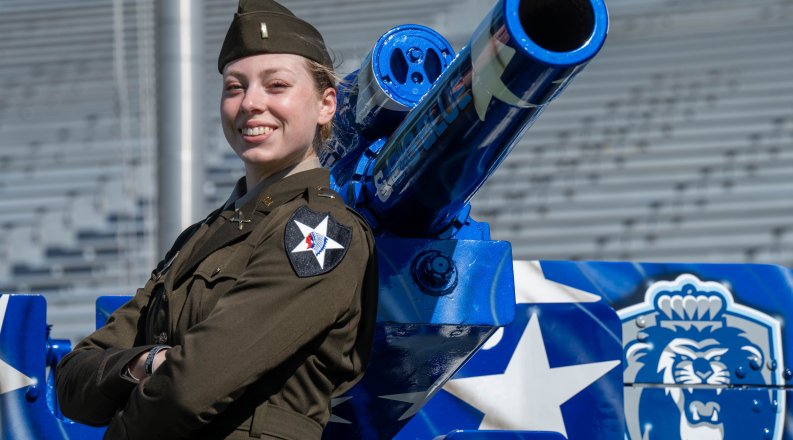


Katherine Proffitt didn’t set out to join the Army.
In fact, when the Williamsburg native arrived at Old Dominion University, she was focused on finding her path — not leading troops overseas.
“I signed up for an introductory military science course with the Reserve Officers' Training Corps (ROTC) just to try something new,” she said. “I never imagined it would turn into a career. But, once I started, I kept going.” That decision would shape the next four years of her studies and life.
Now, graduating from the University with a bachelor’s in international studies and a minor in Japanese, Katherine is preparing to commission as a field artillery officer in the U.S. Army.
In the months ahead, she will complete the Basic Officer Leadership Course at Fort Sill, Oklahoma, before heading to South Korea, where she will lead a platoon of approximately 40 soldiers and assist with operations in her unit.
“I’ll be responsible for leading troops and coordinating fire support,” Katherine said. “It’s an incredible opportunity, one that you simply can’t replicate in the civilian world.”
Her role will include working with rocket and missile artillery and coordinating the employment of field artillery soldiers to ensure precision in high-stakes environments.
While the responsibility is significant, Katherine is ready, even as she acknowledges the uncertainty that comes with it.
“The unknown is probably what makes me the most nervous,” she said. “You don’t always know what you don’t know. But, I trust my training and the lessons I’ve learned through ROTC.”
That training began in a program she quickly came to rely on, not just for leadership development, but for community. “I had an incredibly positive experience in ROTC at ODU,” she said. “The cadre, my mentors and my peers pushed me to grow and supported me every step of the way.”
Katherine’s parents recommended the program to her, but it was her own experience that solidified her commitment. “They were supportive, but this became my decision,” she said. “ROTC challenged me in ways I didn’t expect and showed me what I’m capable of.”
Those challenges were both physical and mental.
“There were mornings when the last thing I wanted to do was get up for a 12-mile ruck march with a 35-pound pack,” she said. “But those experiences taught me resilience. I learned that I can do hard things.”
Katherine’s growth as a leader became especially evident in her role as a senior cadet mentor, guiding younger students as they prepared for the demands of the program.
A few of the junior cadets had expressed their worries about the Army Fitness Test. I helped train them through running, weightlifting, and my own tips and tricks I've learned along the way. Every time one of my mentees comes up to me and says that they achieved a new personal best, it always makes me proud. That's what leadership is about.”
That commitment to mentorship reflects a broader culture within the University’s ROTC program, where leadership is learned through experience and responsibility.
For Katherine, one of the most meaningful moments of that responsibility came during her senior year, when she was entrusted with leading the University’s cannon crew — a group of cadets responsible for firing “Big Blue” at football games and campus events.
“It meant a lot to me that Lt. Col. Brandon A. Shah (’07) trusted me with that role,” she said. “That cannon is such a visible part of campus tradition, and being put in charge of it was a huge honor.”
Lt. Col. Shah, the beloved former Commander of the Army ROTC Monarch Battalion, had worked diligently to acquire the cannon in 2025. Today, the booming sound of the cannon has become a recognizable part of the University game-day experience, and a symbol of the ROTC program’s presence across campus.
“It’s more than just a tradition,” Katherine said. “It shows that ROTC is part of the community.”
That sense of belonging extended into the classroom, where she found an academic path that aligned with her growing interest in global leadership.
Katherine chose to major in international studies, a multidisciplinary program that draws from political science, economics, language and global affairs, building a foundation for the work she will soon take on overseas.
“It gave me a broader understanding of the world and how different systems and cultures interact,” she said. “That perspective is incredibly valuable in a global role.”
Her advice to prospective students is simple: “Take the time to explore what Old Dominion University has to offer,” she said. “You might discover a path you never expected.”
For Katherine, that path is now leading halfway around the world, from a classroom in Norfolk to a leadership role on the global stage. And, while the future may hold unknowns, one thing is certain: she’s ready to lead.