

By 4 a.m., Paige Agnew is already moving — lacing up, heading out and meeting her first clients before most people have even hit snooze on their alarm clock. By midday, she’s on Old Dominion University’s campus in Norfolk, deep in biomechanics research. By evening, she’s back to training. Somewhere in between, she finds time to train for triathlons, rock climb and, recently, teach herself how to crochet.
This month, the Virginia Beach native is finishing her Ph.D. in kinesiology and rehabilitation — part of the Ellmer College of Health Sciences at Macon & Joan Brock Virginia Health Sciences at Old Dominion University. Her schedule is relentless. Her work is precise. And, the question driving it all is: how do you help someone move forward after life changes everything?
Her dissertation focuses on the movement patterns of individuals with lower extremity amputation during walking and running — work that sits at the intersection of science, rehabilitation and real life.
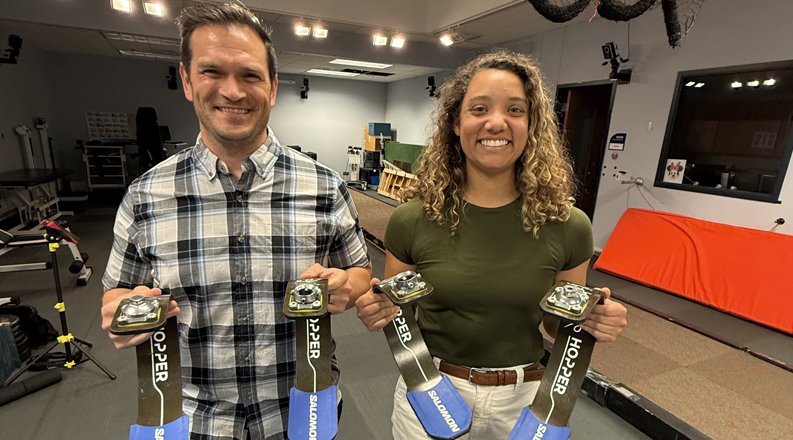
“I connected with an international prosthetics developer called Hopper, located in France, and they sent me some prosthetics for my dissertation,” she said. “My dissertation work is focused on, how does prosthetic stiffness, whether it's more compliant or more rigid, affect our running mechanics.”
In the lab, that research comes to life.
“We had three individuals who had experience running on a prosthetic come in and use our devices. Then, we had three individuals who had never run on a prosthetic run for the first time ever in our lab, and it was absolutely amazing.”
That kind of hands-on, human-centered research is a defining part of the doctoral program in kinesiology and rehabilitation. Students don’t just study movement. They work directly with people, collaborate across disciplines and contribute to research that reaches beyond campus.
Paige’s work spans that full spectrum. In Norfolk, she works with patients recovering from diabetic and traumatic amputations. In Richmond, she partnered with the Mission Gait Foundation conducting research with individuals with diabetic, traumatic and non-diabetic vascular amputations. Last summer, she was at Walter Reed National Military Medical Center, working with active-duty service members as part of a predoctoral fellowship.
The throughline started years earlier with a book she picked up as an undergraduate.
“I read a book when I was an undergrad called ‘Run Don't Walk,’ and it's from the perspective of a physical therapist during the Iraq and Afghanistan wars,” she said. “I just thought it was really cool how she took them from an individual with this extreme injury and was able to help them not only walk again but get back to combat ready.”
That perspective hit close to home. Paige comes from a military family — her mom, dad and brother all served, with her father spending 28 years in the United States Navy. The work she’s doing now connects directly to that world, but it also stretches far beyond it.
Her path to Old Dominion University wasn’t linear. After earning her undergraduate degree at Ithaca College, she interned with Division I athletes at the University of North Carolina at Chapel Hill. Then, Paige moved to Manchester, England, for a master's in exercise and sport biomechanics. A connection with faculty at Old Dominion University eventually brought her back home to Hampton Roads and into a program that gave her room to shape her own research.
“In a lot of programs, you have to work on the research they're doing or that they have funding for,” she said. “But, both Dr. Bennett and Dr. Ringleb were like, ‘We are excited to help you complete the research that you are excited about.’ It's a very welcoming environment.”
That mentorship — paired with access to labs, clinics and community partnerships — is what defines the experience for many doctoral students in the program. It’s also what allows someone like Paige to build a career, while earning her degree. She runs her own strength and conditioning business, commuting forty-five minutes from Virginia Beach and balancing clients, coursework, research and teaching.
She’s spent the last three semesters in the classroom as a lecturer, gaining experience she plans to carry forward. After graduation, Paige hopes to stay in academia, continuing both research and teaching.
“I am very excited to help students find their passion and what excites them and hopefully help them figure out what pathway they can go down that will lead to a fulfilling career,” she said.
That mindset — curiosity, persistence and a focus on what’s possible — is what keeps her moving, long before sunrise and long after the day winds down.
“I think it's really important to show the students that there are different opportunities available out there and some that they might not even know.”
For Paige, that shows up in the way she works and in the people she works with — helping them find what’s still possible, helping them build strength, confidence and a path forward.