

Nature-based solutions — such as restoring wetlands and oyster reefs — help communities manage flooding and sea level rise. But beyond reducing risk, what value do these strategies provide to residents?
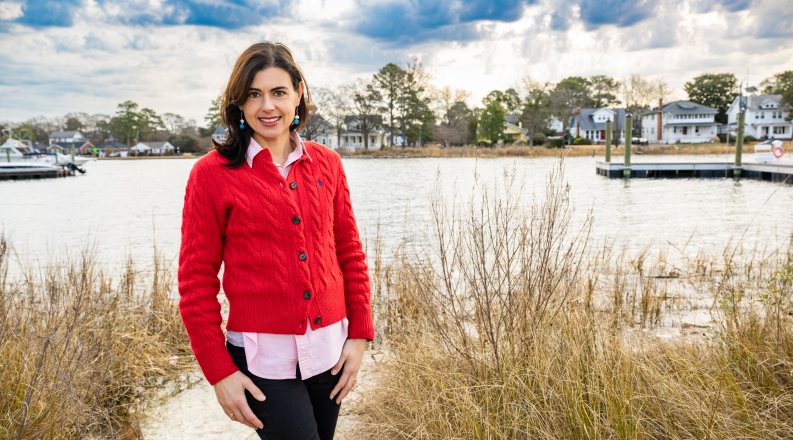
Old Dominion University researcher Laura Costadone, Ph.D., is working to answer that question.
An assistant research professor with Old Dominion University’s Institute for Coastal Adaptation and Resilience, Dr. Costadone uses data and modeling tools to measure the economic and recreational value of green spaces, biodiversity and nature-based flood solutions in Hampton Roads. Her research draws on data from social media platforms and travel sites like TripAdvisor to understand how people interact with nature.
She then translates that information into estimates of the monetary value of existing and potential coastal resilience projects, as well as their benefits for residents’ health and well-being.
“We always keep communities and local government at the center of the research because we want to make sure that what we produce is relevant,” Dr. Costadone said. One of the first projects she worked on after joining Old Dominion University in 2023 was with the City of Virginia Beach to produce a cost-benefit analysis on converting the Bow Creek Golf Course into a stormwater park. A stormwater park is a public work that manages stormwater while providing recreational features like playgrounds, dog parks or nature trails.
Although reducing flooding was the main goal of the project, Dr. Costadone highlighted the recreational opportunities the park would offer to residents and the ecological benefits to the area.
On another project with the City of Norfolk and the Elizabeth River Trail, she plans to analyze user data from the fitness app Strava. Her goal is to understand how residents experience trails and green areas, which will better inform infrastructure planning and tideland mitigation efforts in the city.
Through her research, Dr. Costadone hopes to build trust with residents and help them see the benefits of coastal resilience projects.
“We’re working with local communities to find a better way to implement solutions,” she said. “Ultimately, the goal is to translate these results into policy involving the communities.”
In addition to analyzing the cost benefits of coastal resilience efforts, Dr. Costadone also researches the risks involved with doing nothing. She is currently working on a project with the Hampton Roads Planning District Commission and the Virginia Institute for Marine Science to identify areas in the region that are in danger of negative environmental impacts.
When she travels for conferences in the U.S. and abroad, Dr. Costadone said she hears so much positivity about the work Old Dominion University is doing to address coastal flooding in the region.
“There are so many people working to make things better,” she said. “These days, it’s really what gets me going in the morning. And that’s why I feel like Old Dominion University and this region, we move forward in a good way.”
Dr. Costadone’s research is an example of how Old Dominion University’s Institute for Coastal Adaptation and Resilience is bridging the gap between science and practice, providing expertise and solutions for environmental challenges that affect the Hampton Roads community. Her work — which gets to the heart of what people value in nature — reflects the innovative approach Old Dominion University is taking to affect change and policy in the region.