
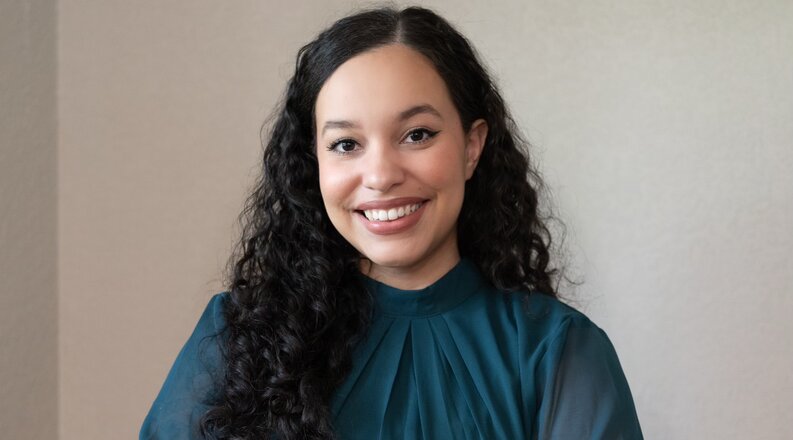


When Melissa Feliciano (B.S.P.H. ’24) left the U.S. Navy in 2021, she thought her future was mapped out. She would become a doctor, work in medicine and help patients one-on-one. But, somewhere between studying public health, working as a medical assistant and volunteering, her vision for creating change grew much larger.
Since graduating with a Bachelor of Public Health (B.S.P.H.) in 2024 — a program that is part of the Joint School of Public Health at Old Dominion University, in partnership with Norfolk State University — Feliciano has been building a career focused on advocacy, equity and improving health outcomes at the systems level.
“I thought that being a doctor was the only way I could help bring equitable healthcare access to everyone,” Feliciano said. “However, while studying public health, I realized that many barriers to care are often systemic and legal. This shifted my focus toward law, where I believe I can better yield my skills for a broader impact.”
She began volunteering as a Court Appointed Special Advocate (CASA) in Virginia Beach in 2025, advocating on behalf of children who have court cases where abuse or neglect is suspected. Feliciano says she wanted not only to help children, but to make sure that law was the right field for her before applying to law school.
That experience proved where her interest lies.
“Advocating for the best interests of neglected and abused children confirmed my passion for the field,” Feliciano said.
In early 2026, she transitioned from working as a medical assistant to becoming a legal clerk in Hampton Roads.
Feliciano came to Norfolk for her Navy service, enrolling in community college before transferring to Old Dominion University for her four-year degree. She says her University coursework introduced her to a broader understanding of health and the factors that influence outcomes.
“Public health helped me realize there are other ways to create change at the systems level,” Feliciano said.
Because advocacy is a key tenant in public health, it’s not surprising to see students like Feliciano find their way to law, said Elizabeth Brown, Ph.D., assistant professor and director of the B.S.P.H. in the Department of Health Behavior, Policy and Management.
“For those interested in policy, advocacy, environmental justice and systemic change, a public health degree can help in understanding and analyzing the systems that lead to legal and regulatory actions, while keeping health in mind,” Dr. Brown said.
That mindset was reflected as Feliciano continued her studies and became increasingly interested in the connections among health, policy and social conditions. She credits public health with expanding her perspective beyond clinical care.
“I had a narrow mindset of what health meant: doctors, vaccines and general medicine,” she said. “Public health helped me realize how many things affect health outcomes.”
While public health is broad, its core competencies include determinants of health, health policy, law, ethics and public health communication — all of which are quite relevant to advocacy and vulnerable communities like children, elderly and lower-income populations, Dr. Brown said. Dr. Brown enlisted Feliciano’s assistance in translating questions into research for a paper that was later published in Frontiers in Public Health, a multidisciplinary open-access journal.
“She was an outstanding researcher and collaborator,” Dr. Brown said. “These analytical questions are great for policy and law, not just public health.”
Feliciano’s experiences in both the legal and public health fields have shaped her long-term goals. She plans to attend law school and continue working with children and families, while exploring opportunities to combine advocacy, policy and public health.
Her education at Old Dominion University is already making a difference — and she plans to build on that foundation to create even more meaningful change.