
Standing in a touch tank surrounded by sharks and rays, Old Dominion University student Olivia Kearse had one of those moments that confirmed she was truly where she wanted to be.
Wearing waders, she moved through the water delivering vitamins to individual animals and recording each feeding. Nearby, a whiptail ray measuring nearly 10 feet long slid past.
“Every time they would brush up against my legs, I was like, ‘Oh my gosh, my life is so cool right now,’” Olivia said.
The moment was years in the making, built on Olivia’s coursework at ODU, research experience in a faculty laboratory and willingness to pursue opportunities beyond campus.
Kearse, a senior marine biology major with a minor in ocean and earth sciences, spent the summer interning with the Interactive Exhibits team at the New England Aquarium in Boston, gaining hands-on experience in animal husbandry, public education and the daily science involved in caring for marine animals.
For Olivia, the internship was another step in an interest that began years earlier. While in high school, she participated in an education program at the National Aquarium in Baltimore and discovered she wanted to work directly with animals while helping others better understand the ocean.
“The ocean is very vast, and what you don’t see, you don’t always think about,” Olivia said. “Bringing a bit of that wonderful biome to people where they can access it freely is very important to me.”
At ODU, Olivia began building the scientific foundation that would eventually follow her into the aquarium.
After completing introductory biology and chemistry courses, she moved into more specialized areas, including marine biology and animal physiology. Her studies gave her a deeper understanding of marine organisms while strengthening the scientific skills she would need in a hands-on environment.
Olivia also found opportunities to take that learning beyond the classroom.
She credits Ian Bartol, Ph.D., professor in the Department of Biological Sciences, with encouraging her to pursue research and hands-on experiences. After talking with Dr. Bartol about career opportunities, Olivia began volunteering in his biomechanics laboratory, adding undergraduate research to the foundation she was building through her coursework.
Dr. Bartol also became a mentor Kearse could approach for advice about research, graduate education and career planning.
By the time she arrived at the New England Aquarium, Olivia was drawing from experiences across her ODU education. She said lessons from the classroom and laboratory contributed to her success at the aquarium, from the scientific knowledge she had developed to the perseverance she learned working through challenging courses.
“It all comes into play, even if it doesn’t make sense when you’re taking it,” she said.
At the aquarium, Olivia had an opportunity to apply that foundation in an environment where careful observation and attention to detail were part of the daily routine.
She helped prepare food and administer vitamins to sharks and rays, identify individual animals and document feedings. Tracking eating habits and behavior can help aquarium staff recognize changes that may require closer attention.
Olivia also created updated identification guides for staff, volunteers and future interns, complete with photographs, identification numbers and physical characteristics that distinguished one animal from another.
“It’s like, ‘Who’s who?’” she said. “They all kind of look the same when you’re new.”
Some animals quickly became easier to recognize.
BB-8, the aquarium’s largest brown-banded bamboo shark, would sometimes approach Olivia during feedings and settle directly at her feet.
“She would just sit on your boot and not leave,” Olivia said. “She was definitely one of my favorites.”
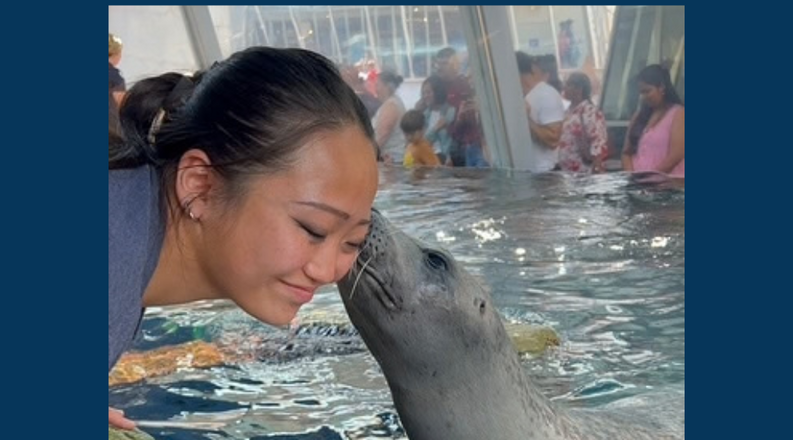
Beyond her work with sharks and rays, Kearse shadowed other aquarium teams, joined whale watches and learned about the care and training of pinnipeds, including seals and sea lions. The experience broadened her understanding of the different careers available in marine animal care and helped her think more intentionally about her own future.
The internship confirmed Olivia’s desire to work with marine animals while expanding her ideas about what that career might look like. She is considering opportunities involving marine mammals, veterinary care, animal rescue and rehabilitation, fisheries or field research.
The summer also challenged Olivia in ways that had little to do with sharks, rays or marine science.
Moving to Boston meant building a life in an unfamiliar city, managing her own schedule and forming new relationships without the nearby support system she had relied on at home and at ODU.
“I had to learn how to stand on my own two feet,” she said. “Seeing that I could do that and flourish the way I managed to this past summer has left me speechless.”
The confidence she gained extended into her professional life. Mentors at ODU and the aquarium encouraged Olivia to ask questions, introduce herself and remain open to learning.
“Never be afraid to reach out,” she said. “Never be afraid to be the first one to say hello.”
For students who question whether they are qualified for similar opportunities, Kearse recommends applying anyway. Academic knowledge matters, she said, but so does the ability to work with others, ask questions, accept feedback and remain open to growth.
“We’re all smart. We’re all capable,” she said. “What sets people apart is that humility.”
Olivia arrived at ODU already knowing she was fascinated by marine animals. Her coursework gave her a stronger scientific foundation. Faculty mentorship led her toward undergraduate research and encouraged her to seek hands-on experiences. And a summer surrounded by sharks, rays and marine scientists gave her a clearer sense of how many directions that foundation could take her.
She hasn't settled on just one.
For Olivia, that's part of what makes a career studying the ocean so appealing.
“The ocean is never the same,” she said.