
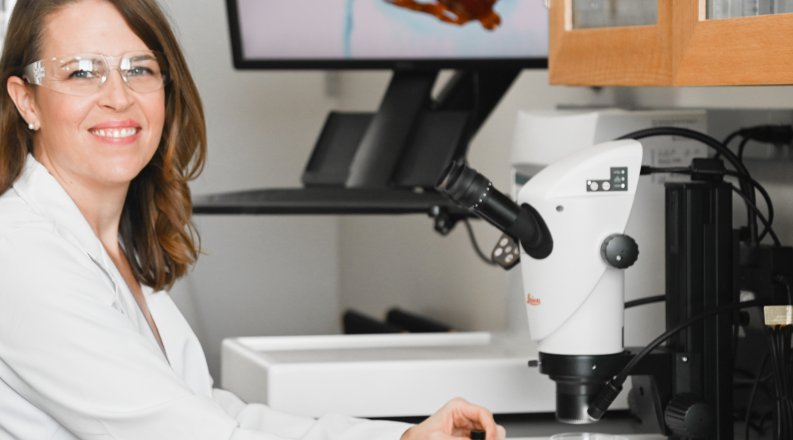


Meet our newest faculty member, Emily Owens Pickle, Ph.D.! Dr. Pickle joined the Joint School of Public Health as an assistant professor in epidemiology on July 25 as the newest member of our growing team! Dr. Owens Pickle holds a Ph.D. in epidemiology from the University of South Carolina and an M.P.H. from Rollins College.
What drew you to public health as a career path?
As an undergraduate, I trained in journalism but realized that I wanted to apply my investigative interests to public service, specifically human health. I was particularly interested in the broader forces that determine why people become sick, remain sick, or experience very different health outcomes. I discovered that investigating diseases is not so different from investigating a news story: both require asking the right questions, identifying patterns, and understanding the larger context. Epidemiology felt like a natural fit - and it literally means "among the people," which is where I want to serve. Today, I am an infectious disease epidemiologist specializing in vector-borne and zoonotic diseases. I am especially fascinated by the intersection of disease ecology, vector ecology and human health, and how understanding those connections can help us prevent disease and empower communities.
What is your previous experience before coming to NSU and the Joint School of Public Health?
I was fortunate to spend many years conducting clinical research in pediatric settings, where I gained much of the foundational experience that has shaped my career. It was also where I realized that I wanted to pursue doctoral training. I had important research questions that I could not fully answer without developing stronger skills in study design, epidemiologic methods and data analysis. During the SARS-CoV-2 pandemic, I was privileged to support the frontline response among vulnerable populations at the Florida Department of Health in Orange County. That experience gave me a deeper understanding of core public health services and reinforced how essential local health departments are to protecting communities, particularly during times of crisis.
What are your research areas, and do you have any current or past research that you’d like to share?
My research focuses on tick-borne and zoonotic diseases—illnesses that can spread between animals and people. Although mosquito-borne diseases often receive more attention, ticks cause most vector-borne illnesses in the U.S. Ticks only eat blood and will aggressively look for their next meal. Relative to their size, ticks carry many different things in their body which can be passed to us during feeding and cause illness. This includes alpha-gal syndrome, which is caused by a tick bite and can trigger an allergy to red meat or other foods, drugs and products containing mammalian ingredients. Mammalian ingredients are included in a shocking number of things we eat, drink, and take as medicine (gelatin anyone?). I recently authored a review on alpha-gal syndrome and am working on several epidemiology studies on this disease, including alpha-gal syndrome in kids.
What is something about public health that you think everyone should know?
One simple thing everyone should know is how to protect themselves from ticks. Think of tick protection like sun protection: when you go to the beach, you put on sunscreen to protect your skin. When you go into the woods, wear permethrin-treated clothing or make your skin harder for ticks to reach by wearing long pants and tall socks. When you come home, check yourself for ticks and take a shower—just as you would rinse off the sand after a day at the beach. A can of permethrin is about the same cost as a bottle of sunscreen. If you do find an attached tick, don't panic. Use tweezers to grasp the tick as close to the skin as possible, then pull straight upward with steady pressure—do not twist or jerk it. After removing the tick, wash the bite area and your hands with soap and water or rubbing alcohol and see a doctor if you develop any symptoms.
Welcome, Dr. Owens Pickle!