



Rhett Epler, Ph.D., assistant professor of marketing in the Strome College of Business at Old Dominion University, sits at his desk in Constant Hall on a cloudy Thursday morning, chatting via video call with a prospective client.
The client, dressed in business attire, remarks on the gloomy weather in Norfolk, Virginia, saying the lack of sunshine must contribute to the coastal city’s charm
before getting down to business.
“Don’t waste my time with fluff,” she tells Dr. Epler.
The interaction may look, sound and flow like a real client meeting with a six-figure deal on the line, but the person on the screen isn’t human at all. It’s an artificial intelligence (AI)–powered avatar created by a cutting-edge software platform designed to simulate authentic sales conversations.
By integrating the AI-based role-playing and simulation tool into Dr. Epler’s professional selling courses, the Strome College of Business is equipping students with practical, real-world experience in a safe, controlled environment, he said. Students can test strategies, refine their delivery and build confidence — all before stepping into an actual sales pitch.
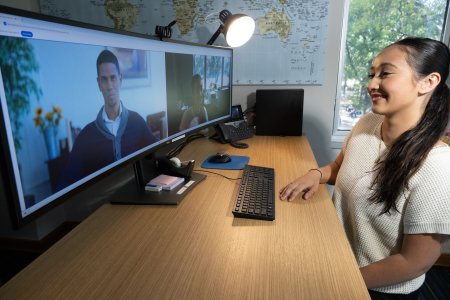
“It doesn’t replace teaching,” Dr. Epler said. “It augments it. We are taking the tension out of a sales interaction and allowing students to get comfortable with what it feels like.”
The AI client adjusts its responses based on the student’s performance, allowing for a wide range of interactions that mimic real-world unpredictability. Instead of memorizing scripts, students must actively listen, think critically and adapt their responses on the spot.
Old Dominion University is one of the first 15 universities to implement the technology nationwide, according to Dr. Epler.
And, with students significantly improving their scores in just six to seven AI sales interactions, the program is an efficient and effective alternative to more traditional role playing. The software helps Dr. Epler avoid what he calls “role-play bottleneck” — when time constraints can prevent him from longer, more involved sales scenarios with each student.
At the completion of the scenario, students are presented with a rubric scoring their sales interactions. They’re graded on dozens of elements, from successfully building a rapport with the potential client to smoothly transitioning from introductions to discussions about the product — all done through the software’s AI. For example, when Dr. Epler demonstrated the software, his score was docked, because he didn’t mention the name of the company for which he worked.
For students, the experience is eye-opening. Many enter the program feeling nervous about the high-pressure nature of sales, but the AI-based role-playing and simulation tool provides a low-stakes environment to experiment and grow, Dr. Epler said.
Maliyah Terry, a senior double majoring in business analytics and real estate, used the AI tool in Dr. Epler’s class. “It allowed us to freely practice real sales conversations without the need of someone else to play the customer,” Maliyah said. “It is much more efficient, and it also allows us to practice with different difficulty levels of customers, simulating real-life scenarios."