


In some communities throughout Hampton Roads and Western Tidewater, children are hospitalized for asthma at nearly twice the rate of children statewide.
Old Dominion University and Children’s Hospital of The King’s Daughters researchers want to understand why — and whether artificial intelligence and geospatial analysis can help reveal patterns that traditional approaches may miss.
According to the Virginia Department of Health, 51 out of every 100,000 Virginia children ages 5 to 14 were hospitalized for asthma in 2024, the most recent year for which data are available. In Norfolk, the rate was nearly 100 per 100,000. Newport News reported about 82 per 100,000, while Chesapeake and Hampton also exceed the statewide rate at about 55 and 54 per 100,000, respectively.
New research aims to better understand those disparities and explore how data could help healthcare and public health professionals respond.
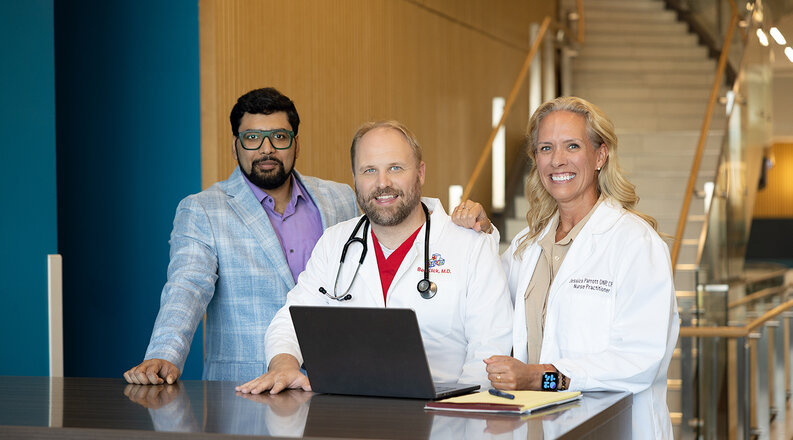
Aditya Chakraborty, Ph.D., an assistant professor in the Joint School of Public Health at Old Dominion University and Norfolk State University, is collaborating on the upcoming research with Jessica Parrott, D.N.P., APRN (B.S.N. ’00, M.S.N. ’03, D.N.P. ’10), and Ben Klick, MD (Pediatrics Residency '18). Dr. Parrott is director of the pediatric nurse practitioner program at Macon & Joan Brock Virginia Health Sciences Ellmer School of Nursing at Old Dominion University, and Dr. Klick is an assistant professor of pediatrics at Eastern Virginia Medical School at Old Dominion University and a CHKD emergency medicine fellow and chair of quality improvement.
The collaboration brings together expertise in population health, pediatric care, nursing, data science and geographic analysis to examine childhood asthma from multiple perspectives. By combining these disciplines, researchers can investigate not only where asthma-related hospitalizations are concentrated, but also what factors may contribute to those patterns and how healthcare systems and community partners could respond.
The team’s project will use local CHKD data and geospatial modeling to examine where pediatric asthma burden is concentrated across Hampton Roads and Western Tidewater and identify potential contributing factors.
The work will build on Dr. Chakraborty's recently published research, which examines whether machine-learning models could help predict current childhood asthma using national data.
In the published study, Dr. Chakraborty and colleagues compared five machine-learning approaches using national data from the Centers for Disease Control and Prevention on asthma attacks and symptoms, medication history, hospitalization, insurance, activity limitations and household exposures.
To better understand how the models arrived at their predictions, the researchers used explainable AI, which helps identify the factors that most influence a model’s conclusions. In one analysis, overnight hospitalization due to asthma and time since the last asthma medication were the two largest contributors.
The new collaboration will take the research a step further by applying this analytical approach to local clinical data and adding a geographic component.
"This is a natural local extension of our published research," Dr. Chakraborty said.
Rather than looking only at overall asthma rates across Hampton Roads and Western Tidewater, the geospatial hotspot analysis could help researchers identify communities where asthma-related burden is concentrated. Predictive modeling could then help investigate patterns associated with that burden.
The information could ultimately help healthcare providers and public health partners better target asthma education, prevention programs, environmental assessments, school-based initiatives and access-to-care interventions, as well as direct community health worker outreach.
"For families, the potential benefit is that a validated local model could help a healthcare system recognize patterns indicating that a child may need closer follow-up before asthma leads to repeated emergency care or hospitalization," Dr. Chakraborty said.
But developing a predictive model is only one part of the process. Researchers must also determine whether its predictions are reliable, whether it performs equitably across demographic and geographic groups, and whether patient privacy is protected. Ultimately, they must evaluate whether the model can meaningfully inform clinical decisions and improve care or resource allocation in practice.
The technology would not replace clinicians or diagnose asthma on its own. Instead, the goal is to develop tools that could support clinical decision-making and help healthcare systems prioritize children who may benefit from additional attention.
The approach could also help address gaps in access to specialized pediatric asthma care. If validated, predictive models could help primary care teams and health systems identify children at greater risk, while geographic analysis could help direct outreach and community resources toward areas with greater need.
“By combining clinical data, advanced predictive modeling and geographic information, we hope to better understand how where children live may influence their asthma outcomes, as well as their access to and use of healthcare,” said Dr. Parrott.
"High accuracy alone is not enough," Dr. Chakraborty said. "We need to understand what is contributing to those predictions."
The planned CHKD collaboration will provide an opportunity to test the approach using local data and examine the geographic distribution of asthma burden.
The goal isn't simply a better model or a more detailed map. It is better information about where children are experiencing the greatest burden, what factors may be contributing to it and how healthcare systems and community partners can respond more effectively.
"AI should be viewed as a tool for making public health information more actionable, not as a replacement for clinicians or communities," he said.