


When national security leaders face fast-moving threats and rapid technological change, the central challenge is rarely a lack of technology or information. Rather, it is knowing how to integrate emerging tools — from artificial intelligence to autonomous systems — into reliable capabilities that work under high-stakes, real-world conditions. It’s using the right tools at the right time to make the right decisions.
To address that critical gap, Old Dominion University has partnered with the Missile Defense Advocacy Alliance (MDAA) to assemble a specialized executive-development initiative: The Aptera MvS Executive Program in Mission Capability Development. Scheduled to launch its inaugural cohort in January, the program brings MDAA’s university-based executive-development model to the Atlantic region, backed by Old Dominion University’s interdisciplinary expertise in mission engineering and applied research.
An East Coast Anchor for Defense Leadership
MDAA has established similar programs and partnerships in other parts of the country, with the University of Southern California, the University of Hawaii and the University of Arizona. MDAA also recently announced a partnership with The George C. Marshall European Center for Security Studies.
The partnership with Old Dominion University creates an East Coast anchor. It builds directly on Old Dominion University’s unique position as a high-impact research university embedded within Hampton Roads — one of the nation’s premier military and defense hubs, home to the world’s largest naval base, fleet and joint commands, shipyards and the defense industrial base.
Bridging Innovation and Real-World Operations
By bringing together the University’s Center for Mission Engineering, part of the National Security Institute, and the Graduate Program in International Studies paired with specialized faculty across cybersecurity, modeling and simulation, AI, and data science, Old Dominion University offers an interdisciplinary environment tailored for senior-level decision-makers across government, the armed forces and private industry.
The program focuses on mission engineering, or the practice of designing and evaluating full operational systems combining technologies, personnel and operational tactics to solve complex defense challenges. Participants will gain practical frameworks with mission capability development, learning how and when to apply research innovations across modern challenges.
Dr. Kenneth Fridley, vice president for research and economic development for Old Dominion University, said the partnership builds on the University's strengths as a high-impact university with deep expertise in emerging technologies, applied research and national security, as well as its location within a region closely connected to the military and defense community.
“We are a comprehensive University but also, we know our location and we know the people we serve, and we know the strong role and impact we can have on national security,” Dr. Fridley said. “So, when we’re talking about our new National Security Institute and advancing technologies to the first responders and warfighters, we’re also talking about doing this with existing leaders and helping them move forward.”
Dr. Fridley said the challenge facing national security leaders is knowing how to bring those resources together when decisions have to be made quickly.
Riki Ellison, the chairman and founder of MDAA, said the rapid evolution of missile defense is changing how the United States and its allies approach deterrence and warfare and creating a need for new approaches to applying technology to real-world missions.
“Winners associate with winners to win,” Ellison said. “We’re associated with Old Dominion University for our nation to win, for our allies to win and to be able to sustain and keep our world order, missile defense and the revolution of its capacity and capabilities has changed the way we deter. It has changed the way we fight.”
A Unique Curriculum
The program will bring together experienced professionals from the military, government and industry to explore how technologies, people and resources work together to accomplish critical missions.
“The emphasis is on applied learning and delivery. We’re going to deliver solutions, not just exposure to technology,” said Dr. Thomas Irwin, executive director of the Center for Mission Engineering. “Participants are trained as architects of the digital front, designing resilient, global solutions required for all-domain operations in a rapidly changing operational environment.”
A select cohort will work through an applied curriculum spanning mission engineering, artificial intelligence, modeling and simulation, cybersecurity, data science, policy and other mission-relevant fields.
Dr. Regina Karp, director of the international studies programs, said the program reflects Old Dominion University’s approach to bringing together expertise that traditionally exists in separate disciplines — from international studies and policy to engineering, AI and modeling and simulation — to address real-world national security challenges.
“I’m proud that the graduate program in international studies can offer the vital national security expertise necessary to translate technological innovation into real-world environments,” Dr. Karp said.
The inaugural cohort is expected to include about a dozen professionals from diverse sectors of military, government and industry. It will be a hybrid model, meeting in-person about twice per month for nine months. At the end of the program, Old Dominion University will award participants a Certificate in Strategic Leadership and Executive Development. The curriculum will span political science, mission engineering, modeling and simulation, artificial intelligence, data science, test and evaluation, cybersecurity, cloud computing, decision science, spectrum operations, international security and collaborative leadership.
By bringing these disciplines together, the program reflects Old Dominion University’s broader approach to connecting research, education and real-world application. Participants will develop a broader view of how emerging technologies, people and systems intersect — and how to turn those capabilities into solutions for complex national security missions.
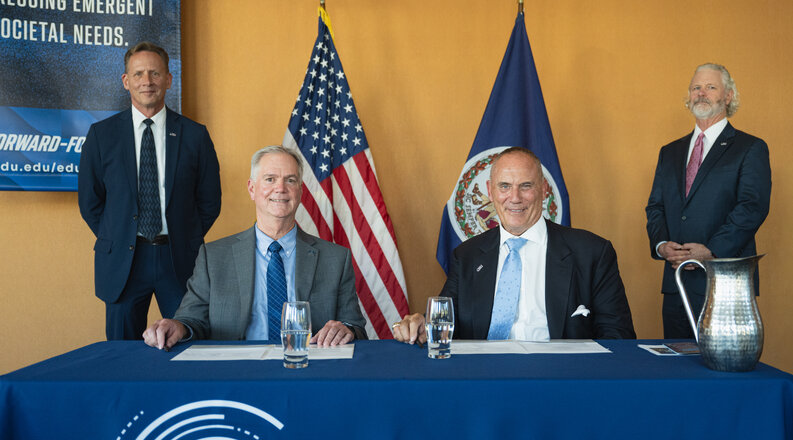
Photo left to right: Dr. Thomas Irwin, executive director of the Center for Mission Engineering; Dr. Kenneth Fridley, vice president for research and economic development; Riki Ellison, founder and chairman of MDAA; and Dr. Eric Weisel, senior associate vice president for applied research and acting director of the National Security Institute, gathered to sign a memorandum of understanding formalizing the partnership in early October.