
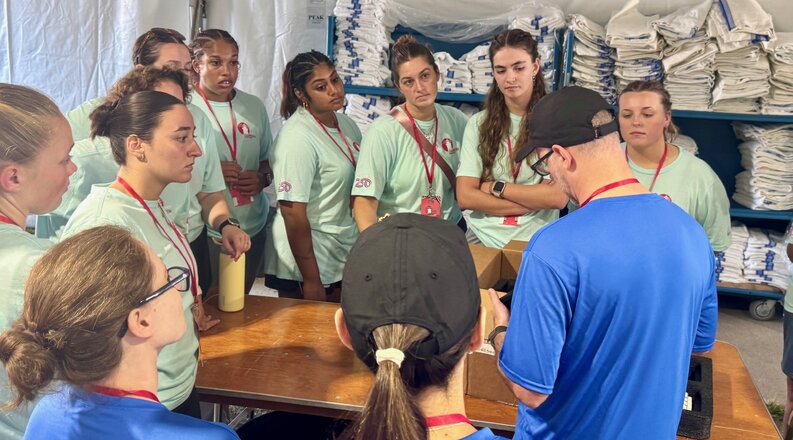


A runner arrives at the medical tent overheated and exhausted. Within moments, everything you learned in class clicks. Recognize the signs of exertional heat stroke. Check the runner’s core body temperature. Begin cooling. Monitor vital signs. And, keep the patient calm.
For six students in the athletic training program in the Ellmer College of Health Sciences — part of Macon & Joan Brock Virginia Health Sciences at Old Dominion University — that was their experience at the ASICS Falmouth Road Race in Massachusetts on August 16.
“You really have to lock in and do what you need to do in order to make sure they're safe,” said second-year athletic training student Kendal Cahill.
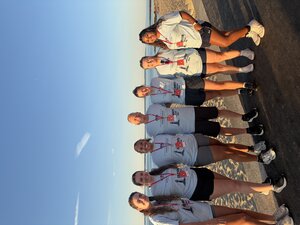
The Falmouth Road Race is no ordinary clinical setting. Now, in its 54th year, the iconic seven-mile Cape Cod race is capped at 11,400 participants and attracts recreational runners as well as elite and international athletes.
For Samantha Scarneo-Miller, Ph.D., ATC, clinical assistant professor in the Master of Science in Athletic Training program, Falmouth is also personal.
Her connection to the race began while she was a student at the University of Connecticut’s Korey Stringer Institute (KSI), where she volunteered as a student and later as a researcher. Nearly 16 years later, she returned with Old Dominion University students and two other faculty members, extending a relationship that connects them with some of the leading experts in athletic training.
Among them is Douglas Casa, Ph.D., ATC, chief executive officer of KSI and an internationally recognized expert on exertional heat stroke. Just months earlier, Dr. Casa visited Old Dominion University to provide hands-on heat illness training for students and health professionals.
“It’s really fun for us to be able to work together in real-world patient scenarios,” Dr. Scarneo-Miller said. For her, one of the best parts is watching students make the connection between what they learned in class and the patient in front of them.
“For me, as a professor, I can just see the light bulb come on.”
About 250 medical volunteers staffed the race, according to Dr. Scarneo-Miller, including athletic trainers, physicians, nurses, paramedics, physical therapists and students. Old Dominion University students were assigned to interprofessional teams in the finish-line medical tent, where each worked directly with patients experiencing heat illness.
Students assessed core body temperatures, helped move patients into cold-water immersion, tracked vital signs throughout treatment and reassured family members waiting nearby.
The experience filled in pieces that classroom practice cannot.
“It’s different for us in class, because we don’t have sick patients to help,” said Graysen Arnold, second-year athletic training student. “We know exactly what to do, but we never have the full picture.”
That changed quickly on race day.
Graysen described feeling her own heart rate rise before treating her first patient, then remembering a lesson from class: “Calm is contagious.”
Working beside classmates, faculty and experienced medical professionals gave the students another lesson in what athletic trainers contribute to emergency care.
“We had physicians there, and people always look for physicians, but athletic training ran the show,” Dr. Scarneo-Miller said.
That included a familiar face. David Csillan (M.S. ’85), Old Dominion University’s first inductee into the National Athletic Trainers’ Association Hall of Fame, was among the athletic trainers working at the race and spent time with the students.
For Dr. Scarneo-Miller, who spent much of race day watching rather than stepping in, that may have been the best part.
“I don't think I touched a patient,” she said.
Instead, she watched students recognize what they had learned and put it into action.
“This was my favorite Falmouth by far,” she said.
The students appear to agree. Several are already talking about returning next year — this time as certified athletic trainers.
“After the fact it was like, ‘We just did that. We just saved those people's lives,’” Greysen said.

PO Box 1980
VA 23501