
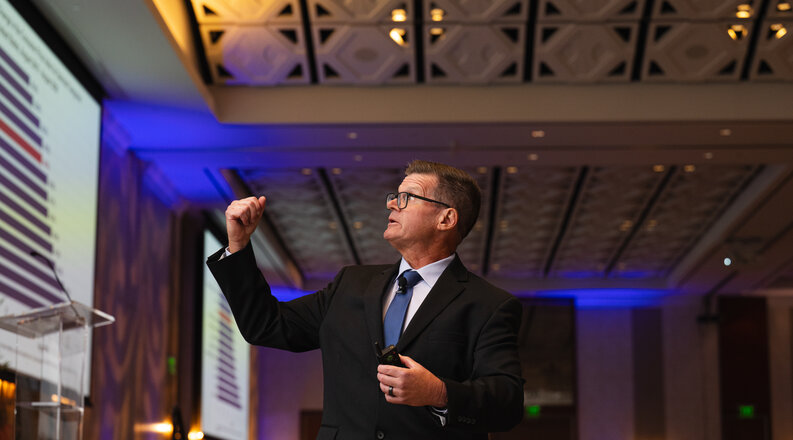


Old Dominion University’s 27th annual “State of the Region: Hampton Roads Report,” produced by the University’s Dragas Center for Economic Analysis & Policy, focuses on the pillars of the regional economy—defense, The Port of Virginia and tourism and hospitality.
At an event that drew more than 700 business and community leaders to the Hilton Norfolk The Main on October 6, the speakers also addressed topics like the price of gas and groceries, the lack of affordable childcare, wastewater management and the value of the arts.
Bob McNab, Ph.D., professor and chair of the Department of Economics and director of the Dragas Center, said the report revealed favorable trends and ongoing obstacles for the region.
“The Hampton Roads economy is really a study in contradictions. It's a mixture of good news and challenges that we must face as a region to move forward," he said.
The good news was that the regional economy continues to expand—the first time that it has grown in six consecutive years since the turn of the century. That sentiment however, was tempered by the fact that the Hamton Roads’ growth falls behind similar areas like Raleigh, North Carolina, or Jacksonville, Florida.
While news from the Port of Virginia is positive—it is ahead of other U.S. ports and with container traffic up 4.3% year-to-date—and tourism remains strong with visitor spending over $7 billion in 2025—consumer pessimism is strong.
Dr. McNab said Americans feel worse about the current economy than they did about the economy during Great Recession. That is fueled by the fact that the cost of daily expenses like gasoline and groceries is rising faster than the 3.4% headline inflation rate.
“At the end of the day, we have to understand that inflation inflicts a psychological toll on consumers, and that psychological toll reflects in how they spend money and how they decide whether to pay or not."
Further regarding inflation, Dr. McNab discussed how inflation acts as a regressive tax where lower-income households face a higher inflation rate than high-income households.
The regional housing shortage, resulting from more than a decade-long decline in construction following the 2008 financial crisis, was another topic. While the median price for a house has continued to increase, earnings have not kept up. The median household earning in 2025 was $86,609, $20,000 less than the amount needed to qualify for a loan for the average median-priced home. Dr. McNab said that regardless of the type of building – whether affordable or upscale housing—any increase in the inventory would benefit consumers.
Barbara A. Blake, Ed.D., chief internship officer and executive director of the Monarch Internship & Co-Op Office, discussed the lack of childcare for children under 5. Calling the dearth of childcare a crisis, she noted that there are only 66,000 preschool/daycare spots available for the 100,000 children under the age of 5. She also reported that a year of childcare can cost more than one year of university education. The economic effects of the crisis include the 65% of workers who must reduce their hours, 41% who don’t take jobs because they can’t afford to have their children take care of the 34% who quit their jobs childcare is too expensive.
Vinod Agarwal, Ph.D., professor and deputy director of the Dragas Center, discussed the report’s chapter called “The Value of Water.” He described how the Hampton Roads Sanitation District and the Sustainable Water Initiative for Tomorrow, is a process that turns treated wastewater into drinking water.
The Dragas Center for Economic Analysis and Policy has produced the State of the Region Report since 1999. It also produces the State of the Commonwealth Report and the Economic Forecasting Project. Reports are available on the Dragas Center’s website.