
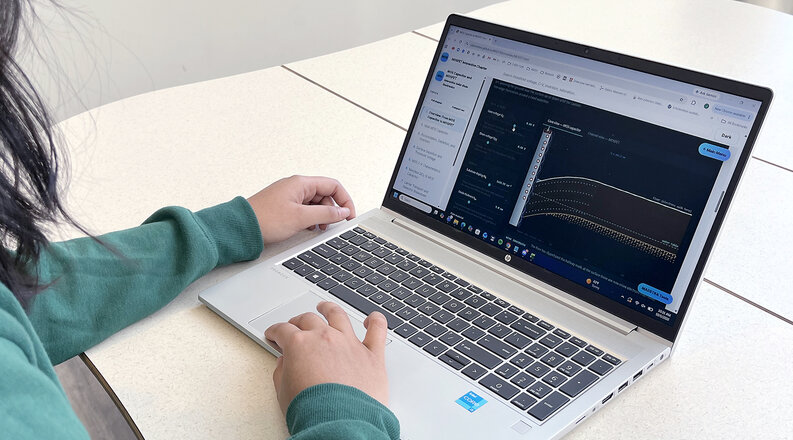


A simulated stretchable surface could give engineering students a way to see what an equation means — not just how to solve it.
At Old Dominion University, researchers are developing an artificial intelligence (AI) tutoring system that combines interactive simulations and guided questions to help students understand difficult engineering concepts — not simply memorize formulas.
The system, called MAESTRA (Metaphor-based AI-powered Engineering Socratic Tutoring for Reasoning and Advanced Synthesis), is being developed by Gon Namkoong, Ph.D., and Jiang Li, Ph.D., professors in the department of electrical and computer engineering. The project is supported by a $400,000 National Science Foundation grant.
“In simple terms, MAESTRA is like having an engineering tutor, an interactive laboratory and a visualization tool working together,” said Dr. Namkoong, lead investigator on the project.
Tian Luo, Ph.D., a professor in the instructional design and technology program in the Darden College of Education and Professional Studies, will lead the evaluation of the system.
The researchers' goal is to address a common challenge in engineering education. Students may learn how to use a formula without fully grasping what it means or how to apply it in a new situation.
“Traditional lectures, active learning and simulations all help, but they are often separated,” Dr. Namkoong said. “Students may see an analogy in a lecture, solve equations in homework and use a simulation later without fully connecting those experiences. I began developing MAESTRA to bring those pieces together.”
For example, when learning Poisson’s equation — one of the most fundamental equations in electrical engineering relating electric charge to potential — a student could use a simulated stretchable surface as a visual model.
The student can manipulate the surface and observe how it changes. The AI tutor then asks questions such as “What changed?” “Why did it change?” and “How is that represented in the equation?” The approach is designed to help students move from an intuitive understanding of a concept to the mathematical principles used to describe it.
MAESTRA also gives students a choice in how much help they receive. Its AI tutor can provide a direct answer or use a Socratic approach by asking questions that guide students toward the answer themselves.
The adaptive approach is similar in principle to personalization used in language-learning platforms, such as Duolingo. When a learner struggles, MAESTRA can provide additional support through Socratic questioning, metaphors, explanations and interactive simulations. As the learner demonstrates mastery, the system can progressively reduce that support and introduce more challenging concepts and problems.
“In a traditional class, an instructor must teach many students at once,” Dr. Namkoong said. “It is difficult to know exactly where each student’s reasoning breaks down or to give every student immediate, individualized conceptual feedback.”
MAESTRA is also designed to give instructors information about where students struggle, how they perform on assessments and how they interact with the simulations.
The researchers emphasize that the system is not intended to replace instructors. Instead, it is designed to supplement classroom instruction by providing students with additional opportunities to practice reasoning and receive feedback.
The team plans to introduce MAESTRA into two electrical and computer engineering courses in Spring 2027, beginning with semiconductor modules and expanding the system over time.
The researchers also hope to integrate MAESTRA into MonarchSphere, the University's AI-powered incubator for students and faculty. MonarchSphere could provide the University's broader AI infrastructure, while MAESTRA would provide specialized engineering content, simulations, tutoring and assessments.
Ultimately, the researchers envision a framework that could be adapted beyond electrical and computer engineering to other engineering and STEM disciplines.
The visual models would change from one discipline to another, but the basic learning process would remain the same by making an abstract concept easier to see, letting students explore it, asking them to explain their reasoning and connecting what they observe to mathematics and new applications.
“The goal is not to have AI solve problems for students, but to help students understand the concepts well enough to solve problems themselves,” Dr. Namkoong concluded.
Through MAESTRA and initiatives such as MonarchSphere, Old Dominion University is exploring ways to use AI to enhance teaching and learning, provide students with more individualized support and create new opportunities for innovation across disciplines. The work reflects the University's broader effort to apply AI thoughtfully to education while helping students build the knowledge and skills they need to succeed.