


A drone that performs flawlessly during a test flight over a parking lot can falter hundreds of miles out at sea, where launching from the deck of a Navy ship means contending with wind, salt spray and open water.
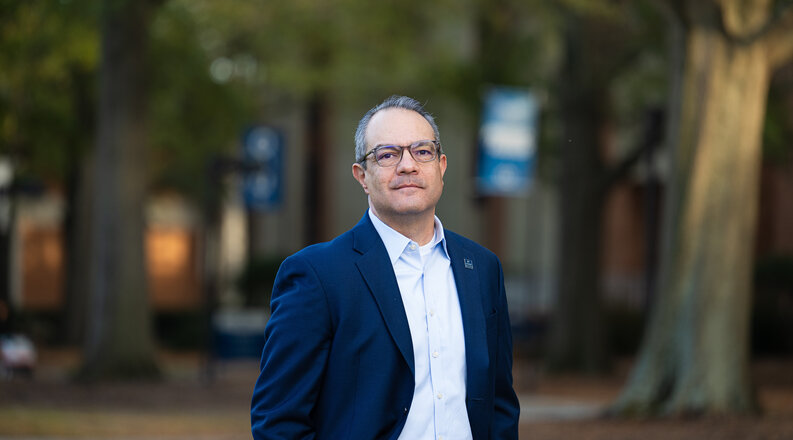
Making technology work in those environments is a problem Matthew Swartz has spent much of his career addressing. Now, as the new leader of Old Dominion University's National Security Institute, he's bringing that experience to a university with deep connections to the military and maritime industries.
Swartz recently joined ODU as associate vice president for national security initiatives and senior executive director of the institute, which brings together the University's expertise in artificial intelligence, modeling and simulation, autonomous systems, cybersecurity and other advanced technologies to support national security research and partnerships.
Coastal Virginia is home to one of the world's largest concentrations of military, maritime and logistics operations, from Naval Station Norfolk, the world's largest naval base, to NATO's Allied Command Transformation and Newport News Shipbuilding, the nation's only builder of aircraft carriers.
Swartz arrives from the Department of the Navy, where he served as executive director to the chief of naval operations and director, Navy Staff (DNS). Before that, he spent almost 10 years in Norfolk, first as deputy commander of Naval Information Forces and then as executive director and chief of staff of U.S. Fleet Forces Command. One of the Navy's most senior career civilian executives, he previously served as executive director of U.S. Fleet Cyber Command, held multiple senior executive roles in the Pentagon and was chief information officer of the U.S. Department of Agriculture's Forest Service. He also held leadership roles at several technology companies.
Swartz discussed his vision for the institute, the challenges of adapting emerging technologies for military use and how ODU can help shape the future of national security. His responses have been edited for length and clarity.
Why isn't winning the technology race enough?
For a long time, the goal has been the constant pursuit of the best capabilities on the assumption that whoever has the most advanced technology wins. In reality, the ability to deliver that technology to the warfighter is much broader than that. It's a bigger ecosystem of things that has to come together.
Take robotic and autonomous systems, the drones and robots that can operate with little or no human control. Commercial industry usually deploys them from land, often to improve the efficiency of a supply chain. But when operating off the gray hull of a Navy ship in some ocean far away from land, you don't have anything like the conditions in a warehouse. Every variable that changes introduces complexity.
Technology is moving because commercial demand is forcing it to move, whether that's AI or autonomous systems. But a military operating environment has a problem set industry doesn't have to solve for their purpose. If you don't understand the environment you're operating in, you end up with technology for technology's sake. That’s the gap.
How did your career prepare you to bridge that gap?
I started out as a technologist. During the dot-com era, I worked for a handful of technology startups in Northern Virginia outside of D.C., looking at emerging technologies for traditional profit-and-loss purposes.
When I moved into civil service, my job was translating those emerging technologies into military capability and integrating them across the defense enterprise. Over time, I evolved from a technology person to running the business side of federal organizations.
In the defense world, where civilian and uniformed leaders work side by side, that's a skill set civilians bring to complement the military operators. And it's not just traditional financial management, HR or IT. It's understanding how you deliver capability, get the most out of the resources you have and align them with the operational outcomes you're trying to achieve. Our military leadership is the best in the world at delivering those outcomes. When you bring civilian business expertise and military operational leadership together, that's where it really works.
Where does ODU fit into that partnership?
ODU sits right between those worlds.
The military needs to make new technology work where it operates, but they need partners who understand its operating environment, the technology space and how to integrate the two into an effective capability. That's what ODU can bring that a traditional technology company can't.
Modeling and simulation is a great example. ODU's capability is world-class, and its partnership with the Joint Staff is incredible. Say you're working on AI, autonomous systems or even additive manufacturing. ODU can take those technologies to the modeling and simulation group and figure out how to adapt them to military operations. That's the ability to close the gap that many places don't have.
And because ODU can integrate across its existing labs, it can simulate military demand and how we actually use these technologies in a national security space.
So, ODU is unique in three ways: its location, the partnerships it already has and the lab structures it has already built.
Why Coastal Virginia?
The partnership among community, academia, the industry base and the national security enterprise is what historically has made the United States different. We deliver capabilities to the military by expanding that ecosystem.
Coastal Virginia is unique in that space. When you think about the entire national security footprint of our region, nobody can emulate that at scale anywhere in the country. The partners here, and even just across the water, from Newport News to Hampton, are a tremendous pool of experts that ODU can partner with and has partnered with.
What makes AI a game changer for national security?
In national security, speed of decision is critical. Operators at the tip of the spear need decisions in real time, and we need to outthink our adversaries at pace, with as much information as possible. When AI makes the decision process more effective, that's a safety-of-life outcome.
But speed alone isn't enough. In the Navy, we looked at everything through a risk lens, and that includes AI itself: a human must stay accountable, and the data must be trusted. Using AI to give commanders the full picture so they can make faster, risk-informed decisions is a real game changer for those operating in harm's way.
Beyond making traditional systems and processes more effective, I see three areas where AI is making the biggest difference.
The first is using large language models to analyze massive amounts of data for tasks we do over and over. That makes the work faster and more efficient, improves the results and frees people from time-consuming manual effort.
The second is difference analysis. AI can establish a baseline and then compare the current situation against it to inform a decision. That applies to everything from data-driven decision-making to biometric analysis, military target recognition and environmental monitoring.
The third is rapid trend analysis. AI lets us run excursions through sophisticated models and simulations far faster than we could before. The advances in digital twins are a great example: we can test scenarios virtually before committing resources in the real world.
At Old Dominion University's National Security Institute, we are already bringing government, industry and academia together to turn these capabilities into real outcomes, and to develop the workforce that will use them responsibly.
What could ODU-NSI mean for students?
The region's growth is creating tremendous workforce demand. And ODU, as the premier university in the region, is positioned to help meet it.
There's an opportunity to more closely align the institute and its research centers with ODU's academic colleges and schools, and with our partners. Together, we can shape our programs, giving our students opportunities they could not find anywhere else, whether through more internships or relationships we can create.
Traditional fields, whether engineering or finance, are important in the national security space. But applying those skill sets to the national security enterprise takes some tailoring.
That could really be a differentiator in how we attract future students: an education different from what they could receive anywhere else and careers inside this ecosystem that are tailor-made for them. There are places that do that extraordinarily well today. But based on what we have, I think we could be world-class at it.
What comes first, and what's your vision for the institute?
A lot of institutions are looking to build similar institutes, and some have. But ODU is different because ODU is already running. The labs are in place. The partnerships are in place. Now it's about bringing them all together under this national security umbrella.
So, for me, it's not about slowing the machine down. I need to understand it as quickly as I possibly can, then look for opportunities to integrate it further and build more partnerships.
I truly believe ODU can be the hub of all of that: It’s already an R1 institution that partners with the region's national security players and with industry and brings advanced research into the conversation. That's what I'm truly excited about. And it will provide tremendous value, not only to the university and its students and faculty, but to this critical mission area.