
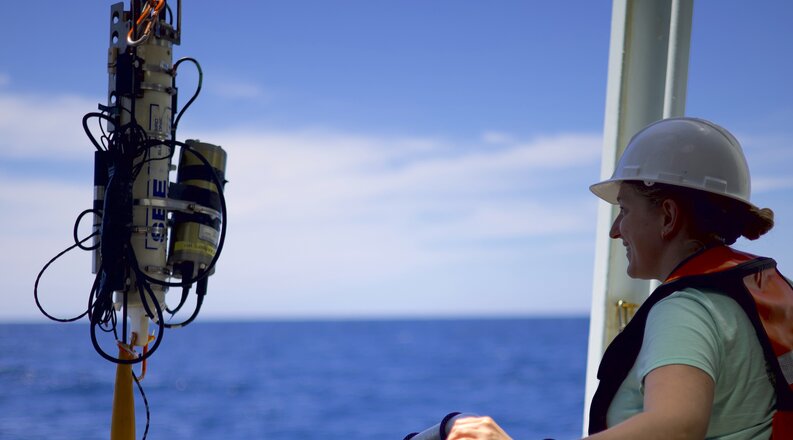


Christina Hernandez, Ph.D. is fascinated with fish.
Just ask her about the lifecycle of a tuna larvae.
“They go from this really tiny thing (about the size of a sesame seed when hatched) and grow to be a fish that can be bigger than a human,” she says with excitement. “It’s amazing, right?”
As an assistant professor of quantitative biology at Old Dominion University, she studies population dynamics and life history evolution of fish and other species.
The research recently earned Dr. Hernández recognition as one of 10 early career fellows selected this year by the Ecological Society of America (ESA), adding to Old Dominion University's growing research expertise in coastal and marine sciences.
ESA’s fellowship program recognizes the many ways in which its members contribute to ecological research, communication, education, management and policy. This year, the ESA governing board confirmed 10 new early career fellows.
When it comes to fish like tuna, which are a food source for humans, this information is crucial to decision makers in managing them.
“As a society, we need to understand what is happening with each population and what is likely to happen in the future, so that we can make smart decisions about harvesting,” she said.
To measure the age and growth of larval (baby) tuna, Dr. Hernández looks at a tiny structure in their heads — called an otolith — that grows in concentric rings, much like tree rings.
Her focus is to use information about larval fish to understand how early life conditions and reproduction influence population productivity, which can inform management decisions.
Dr. Hernández recently went on a research cruise with scientists from the National Oceanic and Atmospheric Administration (NOAA) to collect larval bluefin tuna off the mid-Atlantic coast. The region they sampled, called the Slope Sea, has only been recognized as a major spawning ground for Atlantic bluefin tuna within the past 10 years, opening major questions about the life history, stock productivity and optimal management of Atlantic bluefin tuna. Research by Dr. Hernández and her NOAA collaborators is helping to answer some of these questions.
Previously, her research on tuna spawning in the Phoenix Islands Protected Area, in the Pacific Ocean, was presented to the nation of Kiribati. This helped the I-Kiribati leaders decide to maintain the protected area, although the COVID-19 pandemic and financial concerns eventually led to it being reopened.
“Conservation is not the only priority nations have,” Dr. Hernández said. “As scientists, I think our job is to provide information, but ultimately the government and management councils need to make the decisions.”
Fish research is just one half of Dr. Hernández’s work. She also studies more theoretical questions related to life history evolution, such as “why are some species short lived or long lived?”
She said that short-lived species generally reproduce at higher rates than long-lived species. Think of the differences between grass and trees or fish and humans and other mammals.
One of her goals is to understand the drivers of evolutionary patterns and the conditions that favor different types of species.
She joined Old Dominion University in January after earning her Ph.D. in biological oceanography from the Massachusetts Institute of Technology-Woods Hole Oceanographic Institution joint program. From there, she held postdoctoral positions at Cornell University and the University of Oxford. She also served as the first president of the Society for Women in Marine Science.
Dr. Hernández said that joining Old Dominion University — located near the Chesapeake Bay — gave her a unique opportunity to bridge her two research focuses.
She’s also excited to introduce Monarch students to the science behind the ecology in their community.
“The population of students that come to Old Dominion University is really special, so making sure students from this region are getting opportunities to get involved in research and see marine science as something they can do with their lives is super valuable,” she said.
That commitment will extend into both the classroom and her lab. This fall, Dr. Hernández will teach ichthyology and welcome a master's and Ph.D. student to her research team, providing students with opportunities to participate directly in marine science research. She will also teach a life sciences modeling and simulation course in spring 2027.
From tiny rings in tuna larvae to larger questions about how species evolve, Dr. Hernández's work connects scientific discovery with real-world challenges in conservation and fisheries management. At Old Dominion University, that research also creates opportunities for students to participate in marine science in a region where the health of coastal ecosystems hits close to home.