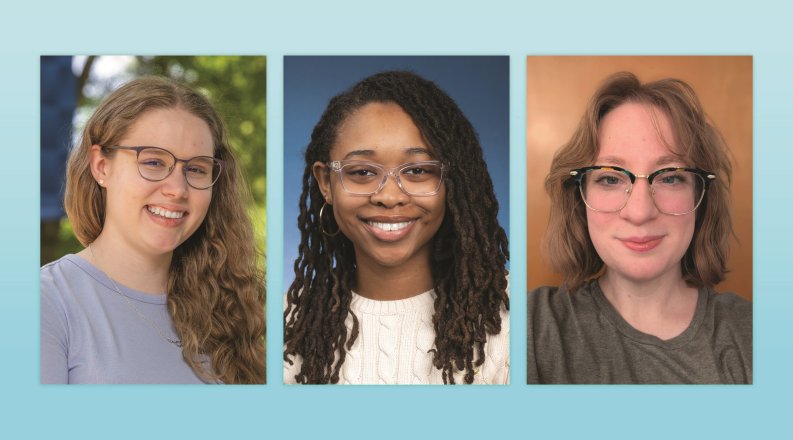


Three recent Old Dominion University graduates are preparing to tackle some of society’s biggest scientific challenges, from developing sustainable pharmaceuticals to restoring wetlands and advancing regenerative medicine, with help from one of the nation’s most prestigious graduate fellowships.
Selected from a pool of nearly 14,000 applicants, Kathryn Bourlier, Olivia Brown and Alana Canty earned National Science Foundation (NSF) Graduate Research Fellowships, a highly competitive award that supports emerging researchers whose work shows exceptional promise. This is the most NSF Graduate Research Fellows the University has had in a decade.
The NSF Fellowship is often referred to as the premier training program for science, technology, engineering and mathematics graduate students.“At Old Dominion University, we want more students to have the chance to do meaningful research, work closely with mentors and tackle real problems hands-on,” said Dr. Kenneth Fridley, vice president for the Division of Research and Economic Development. “Those experiences build confidence, expand what students believe is possible and help them realize they can make a genuine difference in the scientific and technological challenges shaping our future.”
Previous fellowship winners from across the nation have gone on to become global leaders in research and innovation. Steven Chu, Ph.D., a former U.S. Secretary of Energy, who won the Nobel Prize in Physics in 1997 for “development of methods to cool and trap atoms with laser light” was a 1970 Graduate Research Fellow. Jessica Watkins, Ph.D., a member of the 2017 class of NASA astronauts, earned a fellowship in 2012 for geosciences. Google co-founder Sergey Brin was awarded the fellowship in 1993 to support his research into data mining and web search. Olivia, Alana and Kathryn are following in the footsteps of such innovators.
Building Confidence
Kathryn Bourlier, (B.S. ’25), a Ph.D. student studying ecology, earned her bachelor’s from Old Dominion University in December 2025 and just wrapped up her first semester working on her doctorate.
The Portsmouth resident, who initially planned to study early childhood education, took her first biology courses at Tidewater Community College and fell in love with it, shifting her plan from teaching preschool to doing biological research. Her “aha” moment came in a wetlands lab, while working on her bachelor’s degree at the University and her future clicked into place, she said.
Kathryn worked with Erik Yando, Ph.D., an assistant professor in the Department of Biological Sciences, for the past two years, and they frequently discussed graduate school and Ph.D. options. Kathryn worked in Dr. Yando’s Coastal Plant and Ecotone Lab focusing on ecology, conservation and restoration and botany.
Because she already had support, inspiring advisers and was part of a strong research network, Kathryn decided to stay at the University to continue her research through a doctoral program. What hooked her on ecology, though, was seeing how one animal or plant can affect so many other things.
That’s her NSF Fellowship research focus. Kathryn has a literature review planned to nail down her exact topic, but is interested in studying black needlerush, which she believes could be key to wetland restoration.
Once she completes her Ph.D., she has considered becoming a professor and hasn’t ruled out teaching at her alma mater. Something she is passionate about is connecting scientific discovery with community engagement, linking research, education and stewardship to build local capacity for understanding and protecting coastal ecosystems.
As a graduate student, Kathryn has already been a teaching assistant and gets the same joy from seeing a college student understand a concept as she did when she taught preschoolers.
“It’s different teaching adults, but in some ways, it’s very much the same,” said Kathryn. One of the classes she’s taught is the class that drew her into biology in the first place.
Kathryn said the NSF Fellowship could open the door for other grants and opportunities for her research.
A World of Possibilities
Olivia Brown (B.S. ’26), a biochemistry major, has loved science since she was a child, because it helped her understand the world in a new way.
The older the Chesapeake native became, and continued her studies, the more she focused on smaller details and the fundamental building blocks of life.
“Coming to organic chemistry really made everything click, because you can start to understand on the molecular level the ‘why’ behind how the universe works,” said Olivia.
That drive guided her as an undergraduate student. In the fall, she will continue her studies as she pursues a Ph.D. at Baylor University.
Olivia originally planned to study medical laboratory science, because she wanted to help people and do “behind-the-scenes" lab work. However, once she took an organic chemistry class from Kyle M. Lambert, Ph.D., assistant professor in the Department of Chemistry and Biochemistry, and joined his research group, she shifted her focus. She will continue her research this fall when she begins work on her doctorate in organic chemistry.
Being in Dr. Lambert’s research group opened up a world of possibilities for her. He gave her opportunities to attend conferences and work on projects. He mentored Olivia as she began considering graduate schools and applying for fellowships.
“He’s invested a lot of time in me, especially as an undergraduate, which is why I think I have more confidence being in a lab and being more independent,” said Olivia.
Olivia presented through the American Chemical Society’s Division of Organic Chemistry Summer Undergraduate Research Fellowship at Bristol Myers Squibb (BMS). There, she was one of 16 undergraduates whose research was sponsored by companies, such as Pfizer, BMS, Eli Lilly and others. Olivia’s research was sponsored by Pfizer.
She wants to work in the pharmaceutical industry in drug discovery and contribute to the development of therapeutics and engage in green chemistry practices, meaning they are more sustainable and use products or processes that reduce or eliminate hazardous chemicals.
Olivia is interested in this path, because she can conduct research that has a wide impact and still work in a group to achieve the goal.
As an undergraduate, Olivia received the Outstanding Student in Organic Chemistry Award and the Patricia and Douglas Perry Honors College’s 2026 Outstanding Graduate Researcher Award, among other honors.
A Step Past ‘Figuring Things Out’
Alana Canty (B.S. ’26), a biomedical sciences major with a minor in biomedical engineering, is thinking about how she can make an impact for others.
At the University, she found her community in the TRiO McNair Scholars Program, funded by the U.S. Department of Education to support undergraduates who are interested in graduate school and are the first in their families to graduate from college, among other attributes.
“The McNair Program is Old Dominion University’s best kept secret,” Alana said, noting it’s been an instrumental part of her experience as a Monarch. “They supported me in every way and built up my confidence,” she added. “They truly support you, holistically.”
The Chesapeake native plans to attend Cornell University, where she will pursue her Ph.D. in materials science and engineering. While pursuing her bachelor’s at Old Dominion University, she gained additional research experience through transformative opportunities, including a visiting summer program at Johns Hopkins University and a competitive research initiative at Cornell University.
She viewed her undergraduate years as “the time to figure things out.” That path led her to doing biomedical research from an engineering perspective. Alana said her research experiences have not only given her hands-on training in biomaterials and materials characterization, but also shaped the questions she wants to pursue in graduate school.
Alana is interested in researching biomaterials for regenerative medicine and tissue engineering, scientific disciplines in which researchers study and design platforms to enhance the body’s restoration. Her research is most applicable in healthcare, where she wants to focus on using biomaterials that are low-cost, environmentally friendly and sustainable.
Alana credits her mentors for their guidance and support. “Their formative investment in my future inspires me to shoulder the responsibility of passing the torch and igniting passion and curiosity in the next generation of scientists.”
That is also true for her own research.
“I want to make some type of impact on the quality-of-care people get,” she said. She’s leaning toward an industry-focused career after earning her Ph.D., but also loves
mentoring and is keeping an open mind that “anything can happen.” The goal is to change the world, she said — or at least, a community.
What’s Next
The NSF Fellowship funds each graduate student’s research over five years. For Kathryn, Olivia and Alana, that time presents a world of questions, testing and discovery as they pursue their research and find answers to some of society’s biggest scientific questions.
Pictured in the photo above, from left to right: Olivia Brown (B.S. ’26), Alana Canty (B.S. ’26) and Kathryn Bourlier, (B.S. ’25). (Courtesy photos)