
Offers training in global health equity practice, education, research, and advocacy. One resident per year will be chosen to be a Global Health Equity Scholar. Applications will be due in January of intern year with acceptance notification given in February. On top of the pediatric program curriculum, residents in this track:
- Receive preference in scheduling their call-free month in their second and third years to support one month of contiguous global health training and travel each year
- Receive research mentoring to complete a scholarly project focused on global health equity
- Receive guaranteed funding for travel in both years
- Must complete comprehensive online global health curriculum over three years and complete required reading
- Attend Ethics/Cultural Competency and Procedural Skills Workshop prior to global health rotation
- Must facilitate a global health journal club session for peers and faculty and attend a minimum of 50% of global health journal clubs annually
- Will apply for Section on International Child Health (SOICH) grant for travel
- Will be encouraged submit one case report written with trainees and faculty from an global health partner site for publication
- Create and deliver lecture in collaboration with global health partners
- Share what was learned with co-residents and faculty in CHKD Grand Rounds or other academic forum
Global Health Experience
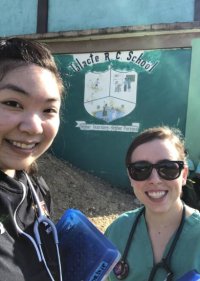
The Global Health Experience is available to any pediatric resident in good standing. We request that residents interested in the experience meet with the Assistant Residency Program Director of Global Health by end of intern year for discussion of goals, timelines, and responsibilities
- The Global Health Experience includes:
- Opportunity to complete a global health training experience ranging from 1 week to 1 month with some funding support (Funding will depend on the number of participating residents each year)
- Encouraged to attend all journal clubs, workshops, and training
- Encouraged to complete any/all online modules in the core training and required to complete one designated online module related to Disaster Response and Clinical Medicine in Resource-Limited Settings
- In return, Global Health track Residents will be expected to:
- Attend an Ethics/Cultural Competency Workshop prior to travel
- Pre-brief prior to travel and debrief after global health elective with Global Health director
- Create and deliver a short educational talk in collaboration with global health partners
- Journaling/reflective writing
- Share what was learned with fellow residents (noon conference, etc)
Although protected time and funding cannot be guaranteed for all residents, any interested resident can request a global health mentor and the residency program will make every effort to financially and academically support residents interested in pursuing the Global Health Equity track. A Residents who completes all track requirements will earn a Global Health Equity track certificate even if they are not the Global Health Equity Scholar of their resident class.
Teaching Hope: A Resident’s Perspective on Neonatal Care in South Sudan
As one of our Global Health Scholars, Anthony Alerre brings a critical and human-centered lens to the unfolding crisis in Sudan. In this AAP Global Perspectives piece, he situates the country’s ongoing conflict within its far-reaching health and humanitarian consequences, drawing attention to the fragile systems that sustain everyday life.
"I am a second-year pediatrics resident currently working as the pediatric consultant at St. Theresa Mission Hospital in Nzara, South Sudan. Although the hospital serves a large population of children and infants, there is no provider formally trained in pediatrics. Every day, the staff cares for some of the most vulnerable patients with limited resources, extraordinary resilience, and deep commitment to their community. My decision to come to South Sudan was shaped by earlier work in Bweyale, Uganda, where I cared for South Sudanese refugees. During that time, I learned that South Sudan has one of the highest neonatal mortality rates in the world. I wanted to understand what those statistics look like in reality—inside hospitals, delivery rooms, and neonatal wards.
A central goal of this experience has been to listen and learn. I am observing how the hospital functions, what capacity exists to care for neonates, and the burden of disease in the first days of life. Just as important, I am learning the emotional toll this work takes on nurses and clinicians who are deeply invested in saving children yet often feel powerless when resources fall short, as I share with them the experience of telling a mother that there is nothing more we can do for her premature baby.
One moment has stayed with me. A critically ill newborn arrived from home with meconium aspiration. The baby urgently needed IV antibiotics and fluids, but despite repeated attempts, the nurses were unable to place an IV. The tension in the room was palpable— everyone knew what the baby needed, and everyone felt the weight of not being able to provide it. I asked for a 5 Fr feeding tube, sterile instruments, suture, and normal saline. Using what was available, we placed an umbilical venous catheter, allowing us to give life-saving medications and fluids.
As we finished, one of the nurses quietly asked, “Can you teach us how to do that?”
That question captured the heart of why I am here. A procedure that may feel routine in a high-resource setting, when adapted thoughtfully, not only gave a newborn a chance at life—it gave the healthcare team hope. Hope that they could do more, learn more, and better serve their community. Before this trip, I worried that my level of training might limit my ability to meaningfully contribute. However, I quickly learned that those fears underestimated both the value of foundational pediatric knowledge and the profound privilege of medical education.
St. Theresa Mission Hospital is currently constructing a new Neonatal Intensive Care Unit, with plans to open in May 2026, alongside ongoing staff training. After I return home, I will continue working with this team through longitudinal virtual education, with the goal of strengthening the capacity of their future NICU and to continue to bring hope to those who are caring for the smallest of patients.
This experience has reminded me that global health is not only about medicine—it is about partnership, adaptability, and empowering passionate providers to care for their most vulnerable patients."
