


For many people, disability is framed as something to overcome. For special education teacher and Old Dominion University doctoral student Tess Pleban (M.S.Ed. ’24), the reality is far more nuanced.
Every day, she celebrates the small, but meaningful “little victories” that signal growth: a student mastering a fine motor skill, discovering a new way to communicate or gaining confidence through greater independence. Those moments inspired her to earn a master's in special education from the University. Today, she is pursuing a doctorate focused on adaptive special education, helping children build independence, resilience and opportunities to thrive.
Working in a range of classrooms, from highly adaptive environments for students who require that extra support to general education classrooms, her goal is to challenge assumptions made about how people function.
“You can’t judge, and you can’t say that just because this is the way you do it, or your neighbor does it, that’s the only way to accomplish a goal or communicate,” Tess said.
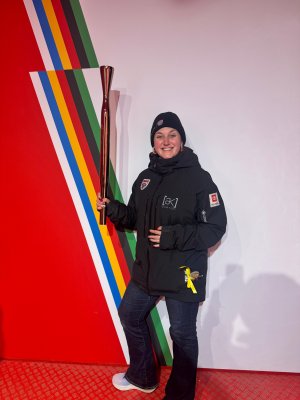
That perspective was reinforced when she traveled to Italy to watch her brother, Joe Pleban, compete in the 2026 Winter Paralympic Games.
He had his left foot amputated in 2014 and had a long road toward recovery and getting back to what he loved — snowboarding. Tess was in high school when this happened. She watched him work toward becoming a world-class athlete ready to compete in the Para snowboarding event.
The same perspective that shapes her work in the classroom was reflected throughout the Paralympic Games. She saw athletes pursuing ambitious goals, supporting one another and embracing opportunities many people might assume were out of reach.
“It’s all these things that these individuals and people in their day-to-day are able to do and overcome,” Tess said. “And, not just overcome, but live their lives. I think that’s the biggest thing with the Paralympics — and the same can be said with special education.”
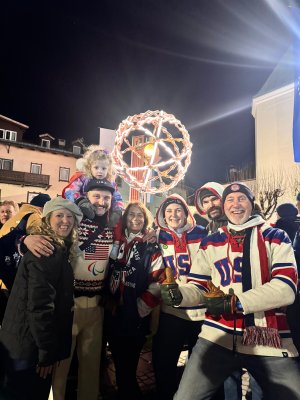
Tess joined her brother and their family in Italy to watch him compete and experience the Games firsthand. She described the atmosphere as loud, exciting and full of support. She was cheering, alongside people from all over the world, and experiencing the joy and pride of being there with loved ones.
“It was really cool to have her there and awesome to have my entire family there, because we’ve been working at this for about eight years to try to get to the Games,” Joe Pleban said. “It was neat to have that support.”
What struck Tess most was how the fierce competitive drive never overshadowed the athletes' or families' mutual respect. Spectators actively moved, along the sidelines, to ensure the mothers and wives of competing athletes — regardless of country — could stand at the front to cheer.
She watched her brother walk through the streets of Cortina, high-fiving competitors from Great Britain, staff members and opposing teams alike. It was a spirit of connection and encouragement that continues to inspire her own work here at home.
Today, Tess balances doctoral coursework with her graduate assistantship under the mentorship of Jonna Bobzien, Ph.D. (B.S. ’96, M.S.Ed. ’03, Ph.D. ’09), professor and assistant chair in the department of human movement studies and special education. Dr. Bobzien’s guidance has helped shape Tess’ path as a scholar and educator.
As Tess continues her studies with Dr. Bobzien at the University, she brings the perspective that disability is a challenge, but not one that prevents someone from living life to the fullest. As a graduate assistant and doctoral student, she gets to work and study with the professors who inspired her during her master’s program and continue advocating for adaptive programming that supports students no matter how they learn and thrive.