

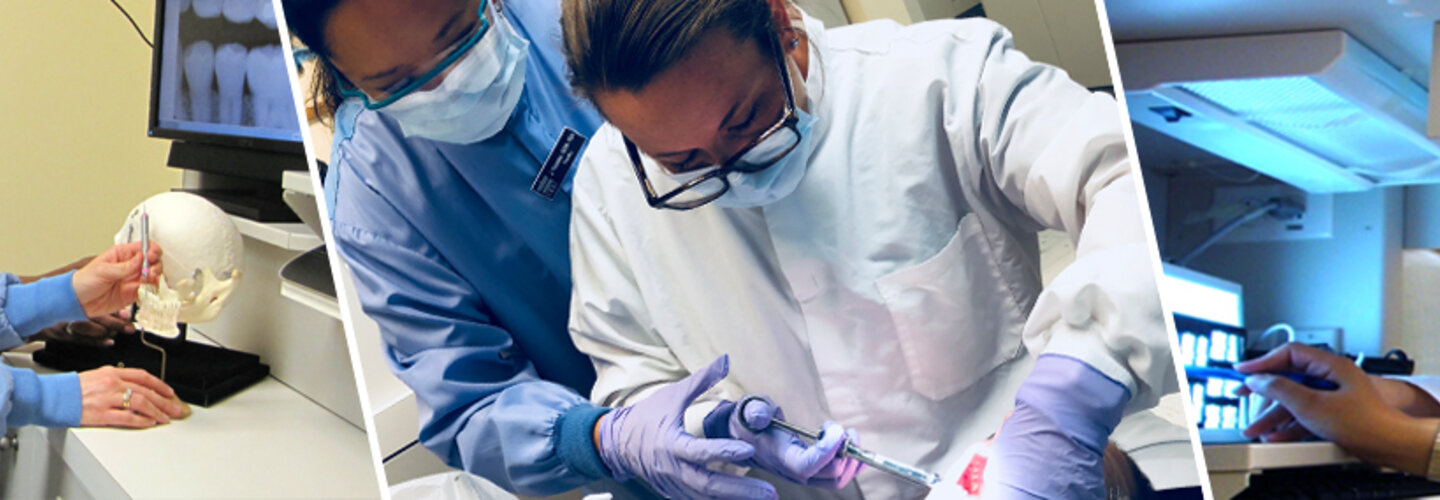
This document is designed to direct the educational process for students as one step to assuring employers and the public of educated, competent dental hygienists who are capable of providing preventive, educational, and therapeutic oral health services in a variety of environments. These competencies define a standard of performance for a new graduate, rather than predict the higher level of performance that will be attained by baccalaureate level dental hygienists over their career lifetime. Implementation and evaluation of Competencies for the Baccalaureate Degree in Dental Hygiene Program Graduate rests with the faculty responsible for the educational programs within the School of Dental Hygiene at Old Dominion University. Ultimately, the true measure of the value of a competency-based education will be the quality of the graduates, the satisfaction of the employers, and the oral health status of the populations served.
The dental hygiene graduate provides clinical care using evidence-based knowledge, professional judgment and skills. The dental hygienist is a licensed professional who must be capable of discerning and effectively managing ethical issues and problems in the workplace. As dental hygiene creates a unique identity for the professional and increases the knowledge base of the profession, the dental hygienist must be able to understand and apply rapidly changing, evidence-based information to a variety of rolesin the employment environment. Therefore, critical thinking, problem solving, and decision-making skills are critical to possess.
- Professional Behavior
The dental hygiene graduate exhibits professional behavior encompassing positive verbal and nonverbal communication, interpersonal skills, and attention to feedback, protocol adherence, thorough and complete documentation, and time management. The dental hygiene graduate must be able to practice collaboratively and in a professional manner.- Adhere to the professional standards of care guidelines.
- Provide accurate, consistent, and complete documentation when serving in professional roles.
- Communicate effectively using verbal, nonverbal, written and digital communications.
- Ethical Behavior
The dental hygiene graduate discerns and manages ethical issues in health care.- Integrate the ADHA code of ethics in all professional endeavors.
- Adhere to local, state, and federal laws, recommendations, and regulations for dental hygiene actions and services.
- Serve all patients without discrimination, appreciating the diversity of the population.
- Apply principles of risk management and quality assurance metrics to manage professional risk, prevent liability and maintain standards of care.
- Problem-Solving & Decision Making
The dental hygiene graduate must acquire, synthesize, and analyze scientific information.- Apply health research information to the practice of dental hygiene.
- Evaluate the safety and efficacy of health products, interventions and treatments.
The dental hygiene graduate provides educational, preventive, and therapeutic services in the support of optimal oral health to diverse populations. The dental hygiene process of care applies principles from biomedical, clinical, and psychosocial sciences.
- Assessment
The dental hygiene graduate collects, analyzes, and records data on the general, oral, and psycho-social health status of patients using methods consistent with medico-legal-ethical principles.- Assess patient concerns, goals, values, and preferences to guide patient care.
- Obtain, review, update, and interpret an accurate medical/dental/ history and vital signs, recognizing conditions that require special precautions or consideration prior to or during dental hygiene care.
- Perform an oral examination and accurately records findings.
- Evaluate the periodontium, and identify conditions that compromise periodontal health and function.
- Identify the need for radiographic images and radiographically distinguish normal from deviations from normal.
- Recognize oral and systemic risk factors that require intervention to prevent and control disease.
- Collaborate with the primary health care team to render safe and effective care.
- Identify patients at risk for a medical emergency and take appropriate precautions to minimize those risks.
- Diagnosis
The dental hygiene graduate applies evidence-based critical analysis and interpretation of assessments to reach conclusions about the patient’s human needs related to individual health literacy, behaviors, attitudes and values of their oral health care needs to make a dental hygiene diagnosis.- Analyze and critically assessing data from diagnostic technologies to determine dental hygiene diagnosis.
- Communicate with the patient and other relevant healthcare providers in congruence with the overall plan for health.
- Planning
The dental hygiene graduate, through collaboration with the patient and other health professionals, must formulate a comprehensive dental hygiene care plan delineating interventions that are evidence-based, patient-centered, culturally sensitive, and related to the identified human needs.- Formulate goals, expected outcomes and obtain informed consent related to the needs and desires of the patient and dental hygiene diagnosis using current technologies.
- Make referrals to healthcare professionals as indicated by the care plan.
- Implementation
The dental hygiene graduate provides specialized care that includes educational, preventive, and therapeutic services designed to assist the patient in achieving and maintaining oral health and wellness goals.- Educate patients to prevent and control risk factors that contribute to oral and systemic diseases.
- Utilize accepted infection control procedures.
- Obtain radiographic images of diagnostic quality.
- Apply basic and advanced principles of dental hygiene instrumentation to remove deposits without trauma to hard or soft tissue.
- Control pain and anxiety during treatment through use of accepted pharmacological and behavioral techniques.
- Provide dental hygiene therapies that can be legally performed in the Commonwealth of Virginia.
- Manage medical emergencies in the patient care environment.
- Evaluation & Maintenance
The dental hygiene graduate must evaluate the effectiveness of educational, preventive, and therapeutic services and modify care plans to achieve patient health and wellness.- Compare actual outcomes to expected outcomes by reevaluating goals, diagnoses and services when expected outcomes are not achieved.
- Develop and maintain a periodontal maintenance program.
The dental hygiene graduate provides promotion and disease prevention activities for diverse populations.
- Education & Communication
The dental hygiene graduate must be able to promote the values of oral and general health to the public and organizations within and outside the profession.- Identify individuals and population risk factors that can be used to develop strategies that promote health-related quality of life.
- Present educational information to diverse patient populations and organizations in a variety of settings.
- Promote overall health and wellness for population-based health within and outside the profession.
- Evaluate the impact of oral disease on overall health to determine patient or community risk and identify intervention and prevention strategies to optimize positive health outcomes.
- Discuss metrics that evaluate the impact of health care interventions on overall health and wellness.
- Evaluate reimbursement mechanisms and their impact on patient access to oral health care.
- Community Involvement
The dental hygiene graduate initiates and assumes responsibility for health promotion and disease prevention activities for diverse populations in a variety of settings.- Assess community oral health needs, risk, and available resources and evaluate outcomes for health improvement and access to the healthcare system.
- Provide oral health promotion and disease prevention as part of interprofessional community health services in a variety of primary health care settings.
- Advocate for effective access to oral health care for all populations.
The dental hygiene graduate provides and demonstrates professional behaviors consistent with dental hygiene parameters of care, legal regulations and the ADHA Code of Ethics. The dental hygiene graduate possesses the values and exhibits behaviors that embody service to the public, professional involvement, and lifelong learning.
- Professional Commitment
The dental hygiene graduate improves the knowledge, skills and values of the profession.- Advance the values of the profession through leadership, service activities and affiliations with professional, community and global organizations.
- Develop practice management and marketing strategies to be used in the delivery of oral health care.
- Professional Advancement
The dental hygiene graduate pursues new knowledge on a continual basis due to the changing health care environment.- Assume responsibility for professional growth through lifelong learning.
- Evaluate professional issues and scientific literature in order to make evidence-based decisions that advance the profession of dental hygiene.
- Advocate for recognition and advancement of the dental hygiene profession.
References
- ADEA Competencies for Entry into the Allied Dental Professionals (As approved by the 2011 ADEA House of Delegates)
- Journal of Dental Education July 201175(7): 941-948
- ADHA Benefits of Dental Hygiene-Based Oral Health Provider Models (April 2016). Available here.
Dental Hygiene Clinic
757-683-4308
Dental Radiation Safety
757-683-5232
Dental Hygiene Winter Weekend
757-683-4804