
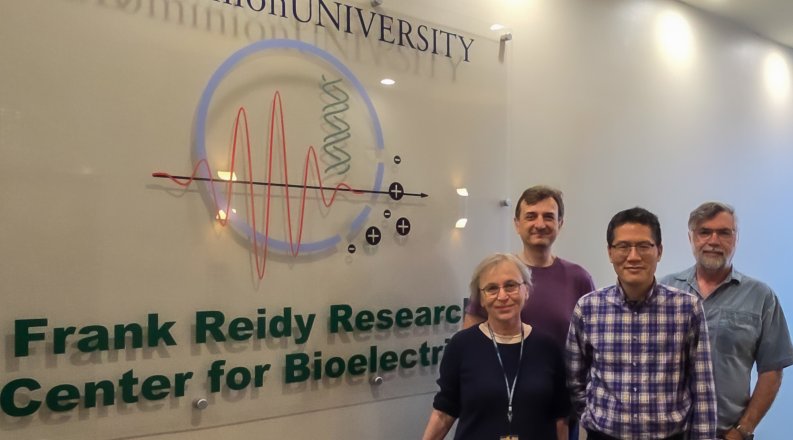


Andrei G. Pakhomov, Ph.D., of Old Dominion University's Frank Reidy Research Center for Bioelectrics, has received a new NIH/NIGMS R01 award for the project "Cell membrane response to electrical stress at nanosecond and nanometer resolution." The project will be carried out with key contributions from faculty co-investigators Drs. Shu Xiao, Olga Pakhomova, and Iurii Semenov, whose expertise spans pulsed-power engineering and dosimetry, molecular and cell biology, live-cell imaging, electrophysiology, and nanosecond-scale measurements of membrane responses. The award provides $320,000 in first-year funding, with anticipated four-year support totaling $1.28 million. The project advances the Center's long-standing leadership in bioelectrics and supports ODU's Health Innovations strategic research thrust by addressing fundamental mechanisms underlying emerging electrical therapies.
The research will investigate how pulsed electric fields interact with living cell membranes at unprecedented spatial and temporal resolution, including the formation, behavior, and repair of individual electropores. The project builds on novel, one-of-a-kind capabilities developed by Pakhomov's team, including dynamic imaging of single electropores in live cells and pulsed-laser strobe microscopy to capture membrane charging and relaxation on the nanosecond time scale. By combining these approaches with electrophysiology and advanced bioelectric pulse protocols, the work is positioned to produce breakthrough insight into how electrical pulses can be tuned either to stimulate cells without damage or to intentionally permeabilize tissues for therapy. The findings may help improve the safety and efficacy of technologies ranging from electrostimulation and defibrillation to gene electrotransfer, cardiac and cancer ablation, and electrochemotherapy.
The content of this announcement is the responsibility of Old Dominion University and does not necessarily represent the official views of the National Institutes of Health.