

As chronic diseases, such as obesity, cardiovascular disease and Type 2 diabetes, continue to affect millions of Americans, healthcare leaders are increasingly recognizing nutrition as one of the most powerful tools for improving health outcomes and preventing disease.
This fall, Old Dominion University is taking another step towards addressing those challenges with the launch of a new online Master of Science in Nutrition program, part of Macon & Joan Brock Virginia Health Sciences EVMS School of Health Professions at ODU. Designed to be completed through ODUGlobal in only 18 months, the program combines scientific rigor with real-world application. The master’s program, led by Salvatore Carbone, Ph.D., RDN, associate professor and program director, will prepare students for careers in clinical practice, research, public health, wellness and other nutrition-related fields.
“What excites me most is the opportunity to help train the next generation of nutrition professionals at a time when the field is evolving rapidly and becoming increasingly important in healthcare,” Dr. Carbone said.
The new M.S. in Nutrition reflects a broader commitment to advancing nutrition science and health across Old Dominion University. In 2025, the University announced the establishment of the Joan P. Brock Institute for Nutrition Science and Health, a multidisciplinary initiative dedicated to integrating nutrition and lifestyle medicine into medical and health professions education, basic science and translational research, as well as clinical innovation and community health.
“The establishment of the Joan P. Brock Institute for Nutrition Science and Health and the launch of the Master of Science in Nutrition program reflect our commitment to advancing nutrition science through education, research and community engagement,” said Alfred Abuhamad, MD, executive vice president for health sciences at Old Dominion University. “Together, these initiatives will help prepare future healthcare leaders, foster innovation and strengthen our ability to address some of the most pressing health challenges facing our communities today.”
The University’s commitment to well-being extends beyond the classroom. As a Health Promoting University, the University is focused on creating environments that support the health and well-being of students, faculty, staff and the broader community. The nutrition program aligns closely with that mission by training future nutrition professionals to translate scientific evidence into meaningful health interventions.
Dr. Carbone’s interest in nutrition began on the tennis court. As a competitive tennis player, he became fascinated by the role nutrition plays in performance, recovery and overall physical conditioning. Over time, that interest evolved into a career dedicated to understanding how nutrition influences metabolism, body composition and chronic disease.
“What continues to motivate me today is the ability of nutrition science to bridge prevention, clinical care and long-term health outcomes in a very tangible way,” Dr. Carbone said.
His research focuses on nutrition, obesity, metabolism and cardiometabolic disease, particularly heart failure. Those experiences helped shape the program’s curriculum, which emphasizes evidence-based practice and the translation of scientific discoveries into real-world healthcare applications. Nutrition program students will have optional opportunities to engage in research and gain hands-on experience by shadowing clinical researchers.
“My philosophy as an educator is centered on scientific rigor, curiosity and real-world application,” Dr. Carbone said. “I believe students learn best when they understand not only what we know, but also how we know it and why it matters.”
Students will explore the physiological mechanisms behind nutrition interventions, while developing the critical-thinking skills needed to evaluate emerging research and apply evidence-based strategies in clinical, public health and community settings. In addition to its online format, the program offers opportunities for hands-on learning through the Sentara Center for Healthcare Simulation and Immersive Learning, where students can practice clinical decision-making and interprofessional collaboration in realistic healthcare scenarios.
The program will prepare graduates for a wide range of career opportunities across the growing field of nutrition. While many nutrition professionals work in hospitals and healthcare systems, opportunities increasingly exist in public health organizations, research institutions, community health programs, food and nutrition service management, corporate wellness initiatives and healthcare leadership.
The program’s curriculum was intentionally designed to provide students with the scientific knowledge, critical-thinking abilities and communication skills needed to succeed across diverse professional settings.
“Ultimately, our goal is not simply to train nutrition professionals, but to develop future leaders, who can translate nutrition science into meaningful improvements in patient care, population health and healthcare innovation,” Dr. Carbone said.
The first cohort of students for the M.S. in Nutrition begin their studies in Fall 2026 at the University’s medical campus in Norfolk, Virginia.
Learn more about the Master of Science in Nutrition.
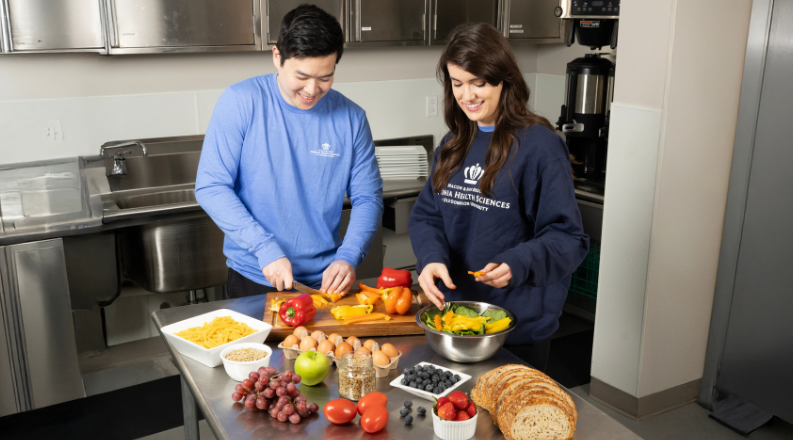
A state-of-the-art metabolic kitchen, used to prepare and analyze meals, is planned as part of the Joan P. Brock Institute for Nutrition Science and Health. (Pictured at top: Maria Puglese, MD Class of 2028, and Theodore Chin, M.P.H., MD Class of 2029)