


Americans are feeling worse about the economy than at any point in the past six decades, and economists say rising costs, slowing job growth and continued uncertainty are fueling that pessimism.
Bob McNab, Ph.D., professor and chair of the department of economics and director of the Dragas Center for Economic Analysis and Policy, and Vinod Agarwal, Ph.D., professor and deputy director of the center, delivered Old Dominion University’s annual Midyear Economic Forecast on June 5 at the Newport News Marriott at City Center. The event, presented by the Virginia Peninsula Chamber of Commerce and held in partnership with the University’s Strome College of Business, drew nearly 300 business and community leaders.
Dr. McNab said the economy will continue to slow until the war with Iran ends. Even then, he said gas prices, which are currently around $4.20 per gallon in Hampton Roads, will not decrease until traffic in the Iran-controlled Strait of Hormuz returns to normal — a process that will take months if not more than a year. He predicted the national average for the price of gas will reach $5 per gallon this summer.
Dr. McNab’s discussion focused on the decline in U.S. consumer sentiment, which dropped from 52.2% to 44.8%, based on consumer surveys from the University of Michigan.
“That's not just a low for this decade. It’s not just a low for this century. It is literally the lowest value ever recorded in the history of the survey over six-plus decades,” Dr. McNab said. “Americans aren't very happy about the state of the economy, and when you ask them about their personal financial situation, it is literally the highest recorded percentage of Americans saying that their financial situation is getting worse.”
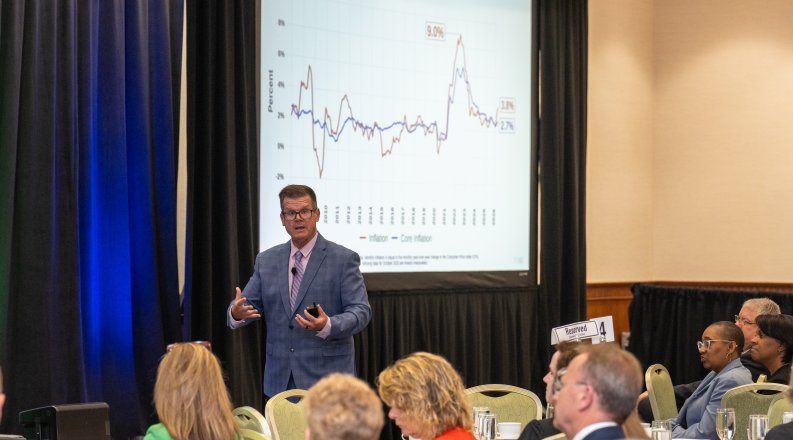
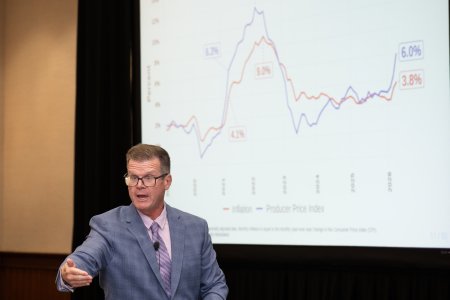
One reason for the consumer sentiment is the rise of inflation. The Bureau of Labor Statistics reported headline inflation rose to 3.8% in April 2026. However, frequent purchases like gasoline and coffee increased by 20 to 25% between April 2025 and April 2026
“The things you consume the most frequently are increasing much more rapidly than the average rate of inflation,” said Dr. McNab. “Your expectations about future inflation increase even more rapidly, you become even more pessimistic about the state of the economy, and then you get the feeling that you're falling behind.”
The economic state of the Commonwealth of Virginia could be summed up by the title of one of the presentation slides: “Higher Prices, Fewer Jobs and Lower Growth.”
Tariffs, changes in immigration policy and general policy uncertainty continue to drive economic news. Traffic through the Port of Virginia was lower in 2026 when compared to pre-tariff levels. Job growth has slowed, with significant losses in the federal government and information technology sectors, and there are fewer Virginians at work or looking for work compared to last year.
Dr. Agarwal’s presentation focused on the labor and housing markets in Hampton Roads. He noted that housing prices continue to rise, and inventories are beginning to increase.
“We seem to be moving slowly and steadily towards what we call a normal housing market. The number of homes sold has increased,” he said. “Listings have increased because all those individuals who were used to 3% rates are now getting used to 6% rates.”
He reported that in some places, such as Jacksonville, Florida, and Charlotte, North Carolina, where more housing has been constructed, rental prices have declined. Whereas in Hampton Roads, the lack of inventory leads to inflated rental costs. He said nearly 56% of renters in the area are cost-burdened, meaning that they spend more than 30% of their income on rent.
Dr. Agarwal also discussed Hampton Roads’ dependence on the federal government, which he said is both a blessing and a curse.
“We need to foster private sector growth,” he said. “We need to diversify the economy, realizing defense-related industries are an asset — we need to keep those—but we need to generate some more assets.”
The Dragas Center for Economic Analysis and Policy has produced influential State of the Region reports for Hampton Roads since 1999. The center’s economists also conduct forecasts for the nation and the Commonwealth of Virginia. Read the Midyear Economic Forecast report and other reports by visiting the website.