
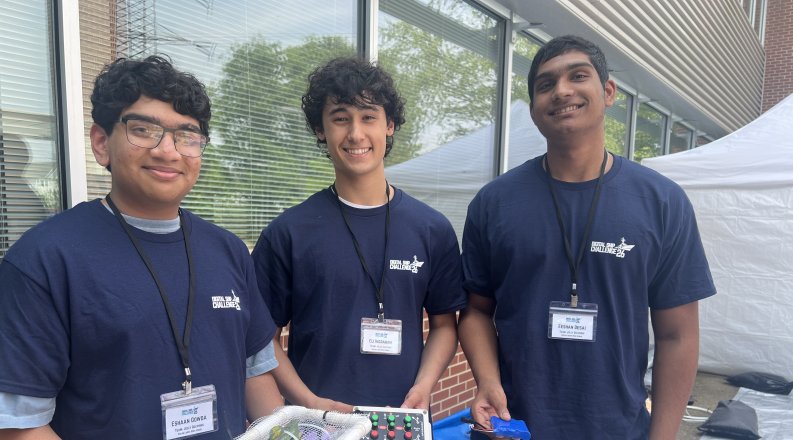


As the maritime industry looks to build its future workforce, Old Dominion University is helping high school students dive into shipbuilding, engineering and emerging technology through its annual Digital Ship Challenge. Organized by the University’s Virginia Digital Maritime Center (VDMC), the challenge drew more than 120 local high school students together for a hands-on STEM competition focused on submarine building and maritime careers.
The event was held this spring at the Virginia Modeling, Analysis and Simulation Center (VMASC) in Suffolk. Now, in its third year, the Digital Ship Challenge expanded from seven teams in its inaugural competition to 39 this year. The competition teemed with energy, bringing together students demonstrating their final designs, VDMC staff, industry professionals and volunteers from the University’s Student Propeller Club.
The Digital Ship Challenge was created by Jennifer Renne, curriculum coordinator at VDMC, to address the maritime industry’s need for workers. Workforce development, along with digital analytics and technology insertion, is a pillar of the VDMC’s mission. Its programs create a pipeline from education to industry.
She said her first goal when creating the challenge was to engage students with a hands-on project.
“What better way to do that than to come up with a challenge. Because everyone, including every student, loves a competition,” said Renne.
With guidance from their teachers and mentorship from local maritime industry experts, the teams worked throughout the school year, gaining hands-on experience and real-world insights into shipbuilding, maritime systems, engineering and emerging technologies. The challenge included three divisions: design, technology and systems.
In the design division, 28 teams, including 88 students, designed submarines that could submerge, travel underwater and resurface. The task demonstrated buoyancy, stability, propulsion and waterproofing.
For the systems division, five teams, including 15 students, built a submarine freshwater piping system and then redesigned it to adapt to a new spatial constraint. Systems had to be watertight and capable of delivering accurate flow rates.
For the technology division, six teams including 21 students, built a remotely operated vehicle capable of navigating in a simulated “no-visibility” underwater environment using sensors instead of sight.
Jessica M. Johnson, Ph.D., a research assistant professor for VDMC and director of the Applied Cognitive Engineering and Simulation Lab, helped run the design challenge and noted the high number of teams that successfully completed the tasks.
“It’s great to see their creativity, specifically in how they are using different types of propulsion. Some are using air and some are using electrical systems,” said Dr. Johnson. “It’s really neat to see the different designs and the ideas behind how they've designed their submersibles.”
Team Jolly Dolphins, from Ocean Lakes High School in Virginia Beach, was one of the competitors at this year’s challenge. The team, composed of senior Eli Ingraham and juniors Eeshan Desai and Eshaan Gowda, enjoyed seeing the designs created by other teams. They agreed that another highlight was the Newport News Shipbuilding Mobile Experience (MX) Trailer which was staffed with shipyard professionals who discussed virtual reality, robotics and laser 3D imaging stations.
As part of VDMC’s workforce development pillar, the team produced the Next Steps Life Skills sessions. Jessica Galassie, MBA, senior program manager, and Devon Nelson (B.S. ’23), multimedia artist, interacted with students in a hands-on career readiness session where students practiced interview skills, strengthened their LinkedIn profiles and improved their resumes.
Students also enjoyed playing DeepData: The Smart Submarine Factory Game, a board game created by Jason Dudley (M.S.Ed. ’22), VDMC’s learning engineer. The board game challenges players to build advanced submarine systems, while navigating the manufacturing process.
Throughout the year, the teams experimented with designs and developed prototypes, documenting everything in an engineering notebook. Renne said it was satisfying to see the students' problem-solving abilities progress over the course of the year as their ideas became reality.
The teams gathered halfway through the year to touch base.
“At the midyear check-in, they saw the space where they'd be testing their designs and had the chance to ask our maritime and engineering professionals questions,” said Renne. “This year, we added the Maritime Connect event with maritime industry representatives so that the students could talk with and ask them targeted questions about their challenge”
At the event, students visited with representatives from Old Dominion University’s School of Supply Chain, Logistics and Maritime Operations, Q.E.D. Systems, Inc., Norfolk Naval Apprentice Program, Hampton Roads Workforce Council and the U.S. Navy’s Submarine Industrial Base.
A career panel was also held at the Digital Ship Challenge featuring representatives from Colonna’s Shipyard, Dominion Energy, Newport News Shipbuilding, Fairlead and Old Dominion University student Shivani Patel, the marketing officer of the Student Propeller Club. Shivani, who recently graduated with a degree in business analytics, shared her journey as a student and young professional. She joined other Student Propeller Club team members teaching the high school students how to play the prototype board game.
“It was inspiring to see high school students so invested in maritime and engineering,” said Shivani.
That enthusiasm was visible throughout the competition as students tested designs, solved engineering challenges and connected with industry professionals. All experiences VDMC hopes will inspire the next generation of shipbuilders, engineers and maritime innovators.