

Twenty years after earning his GED, George Degaraff decided it was finally time to bet on himself.
After years of physically demanding jobs – from construction sites to delivery routes – too many moments that left him feeling underestimated, George found new motivation watching his fiancée earn her registered nursing degree. In his mid-30s, he started at Old Dominion University and was determined to build a future on his own terms.
In Fall 2024, he enrolled at the University to pursue a bachelor’s degree in history. It was the second step in his return to academia. His first was earning an associate’s degree in social science at Tidewater Community College in Summer 2024.
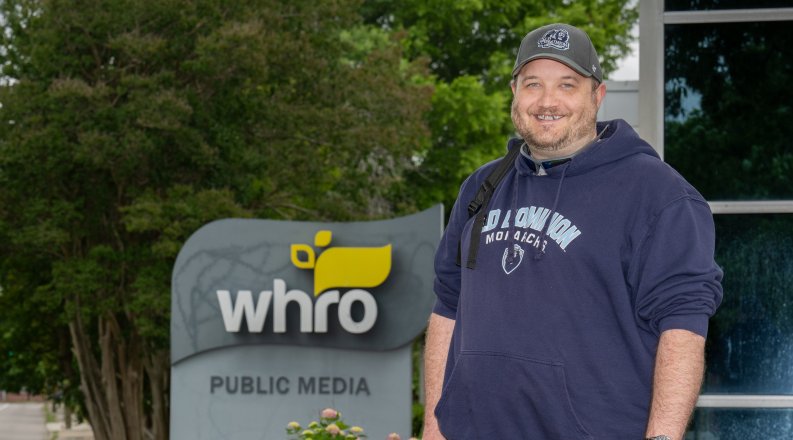
George’s path led to two internships, one at Old Dominion University’s Special Collections and University Archives and another at WHRO, a Norfolk-based National Public Radio affiliate. Both gave him the opportunity to put his newly gained classroom knowledge to use.
At the radio station, George worked as a historical research intern and contributed to a project on the American Revolution in support of the nation’s 250th anniversary commemoration. The series, which launched July 4, 2025, examines the American Revolution through the lens of Hampton Roads and Norfolk and will continue through July 4, 2026.
“There’s so much more history in Hampton Roads than I think people realize,” said George, who was part of a small production team focused on research.
His internship application caught the attention of Connor Worley, WHRO’s lead producer and host.
“George stood out immediately. I could tell this is someone who’s already passionate about history,” Worley said, adding that George quickly became an essential part of the team.
“He’s been so vital to what we’ve done here,” Worley said.
“I felt a strong sense of responsibility to make sure stories were told correctly, because I’m from here.” - George Degaraff
At the University’s Special Collections and University Archives, George applied his humanities-specific skills he learned as a history major to his work.
Elizabeth Zanoni, Ph.D., an associate professor of history and the director of the Monarch Humanities Internship Academy’s Internship Studio, worked with George and saw the impact his experiences had on him.
She described how he left the archives internship with a richer understanding of the historian’s craft, hands-on experience in the field of archives management and professional development, as well as networking opportunities.
“George’s journey as a student and intern offers a wonderful example of how the Monarch Humanities Internship Academy can enhance a student’s academic experience,” she said.
George secured both internships through the Monarch Humanities Internship Academy, part of the University’s Monarch Internship and Co-Op Office. Supported by a $5 million grant from the Mellon Foundation, the academy provides paid, hands-on opportunities for humanities students and expands access to internships that might otherwise be out of reach.
Every student who receives the Mellon Award must enroll in an internship course. Because financial circumstances can be a barrier to internships, students can opt to take them for zero-credit, eliminating the cost of tuition, or earning credit toward their degree requirements.
George did his archives internship for zero credit, and he chose WHRO internship for credit, which would normally incur an expense. But, the Mellon Award covered the cost of the credits and left George without having to foot the bill.
One of the University’s strategic goals is to identify and reduce barriers to student participation in internships and other work-based opportunities. That means not only connecting students, like George, but expanding opportunities for them with grants. One of the University’s priorities is for every student to have the experience before they graduate.
“Internships beget internships,” Dr. Zanoni said. “George’s experience in the archives prepared him to apply for and secure his historical research internship position with WHRO.”
For George, work on the WHRO series carried personal meaning.
“I felt a strong sense of responsibility to make sure stories were told correctly, because I’m from here,” he said. “It’s not just the history of America and Hampton Roads. It’s also my own history.”
The experience also reinforced his decision to return to school.
George said he was not ready to pursue higher education after high school. He later earned his GED after leaving school in 10th grade, but eventually found his way back to the classroom in a place familiar to him as a Hampton Roads native.
“I think as time has gone by, I’ve been able to get myself in the right place,” he said.
Earning a degree, he added, is something he is doing for himself.
“This internship confirmed I chose the right direction,” he said. “I’ve never had so much fun at a workplace that I got paid for.”
Recounting all the jobs he worked before enrolling at the University, George said these jobs have given him many skills. But, his internships have provided a different kind of experience. The contrast has been striking, and the skills he picked up in both internships are likely to support any career he pursues. He is interested in researching historical legal cases or working in some capacity in the legal field.
George’s ties to Old Dominion University began long before he was a student. He grew up in Hampton Roads, living in Suffolk, Portsmouth and Chesapeake. His father was also a Monarch, and George recalls spending time on campus as a child. But, coming back as an adult has changed his trajectory.
Returning to school has reshaped how he approaches learning.
“It taught me to be patient,” he said. “You need time to process what you’re learning. College doesn’t happen overnight.”
Kenya Godette, director of news and media relations, contributed to the reporting of this story.