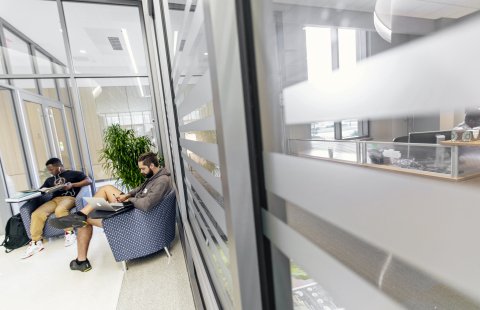
The Department of Ocean, Earth, & Atmospheric Sciences acquires and disseminates knowledge of the earth system, including the relationships among the biological, chemical, geological and physical components of our planet. It is critical that we understand both natural and human-induced processes that change this system so we are prepared to meet present and future challenges. With curiosity, creativity, scholarship, and respect as cornerstones of our philosophy, we strive to increase scientific knowledge and literacy through excellence in research, education, and service to the Commonwealth of Virginia and society in general.
The Department of Ocean, Earth and Atmospheric Sciences has evolved over the past decade to have an expertise in ocean margin and coastal system processes and coupled quantitative models. In this context, the coastal system comprises all the processes, past and present, that occur within and between the air, water, soil and rock of the coastal plain, continental shelf and slope, and focus on coupled quantitative models that link chemical, biological, geological, hydrological and physical processes in numerical and analytical models at regional to global scales. Given the local environment (estuaries, aquifers, coastal waters) and human demands (commercial ports, military operations , fisheries and recreation), it is appropriate that this type of focus has evolved. While research interests remain broad to maximize opportunities, we are taking advantage of our location to develop a long-term line of research that will be recognized internationally. Similarly, our education programs utilize the local environment to provide students a unique experience in the classroom and in the field.
People
One department, multidisciplinary.
History
We have come a long way.
The Fleet
Check out our fleet of research vessels!
Academic Program
The Department of Ocean, Earth & Atmospheric Sciences at Old Dominion University offers various programs in Ocean and Earth Sciences. Click here for more information about our undergraduate program, and here for more information about our graduate program.
Faculty
There are currently twenty-three full-time faculty members in the Department of Ocean, Earth & Atmospheric Sciences at Old Dominion University. In addition, there are faculty members in other departments at ODU whose research interests are in the field of ocean, earth & atmospheric sciences. Many of these are Joint Faculty or Adjunct Faculty in the department.
Norfolk, Virginia is one of seven major cities comprising Hampton Roads, one of the world's largest major seaports. Norfolk is the center of this Eastern Virginia region and the hub of the world's largest natural harbor. It is a major center of research and development and a home for extensive scientific and technological activities in marine science, aerospace technology, ship design and construction, advanced electronics and nuclear physics. NASA-Langley, the birthplace of the space program, is located in Hampton, Virginia.
First established in 1969 as the Institute of Oceanography, the Department of Ocean, Earth and Atmospheric Sciences moved into a new building on the Old Dominion University campus in Norfolk in 1997. New facilities contain laboratories for biological, chemical and geological studies. In 1991, the Commonwealth Center for Coastal Physical Oceanography began operation in a building near the campus and houses all of the physical oceanography laboratories.
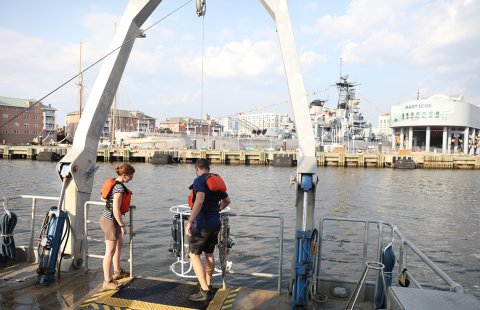
The Department maintains a 55-foot research vessel, the R/V Fay Slover. Smaller vessels, suitable for near shore investigations, are also maintained by the department. Research requiring larger vessels is made possible through the cooperation of such government agencies such as NSF and the National Oceanic and Atmospheric Administration. Old Dominion University is a member of CRC (Chesapeake Research Consortium), COL (Consortium for Ocean Research and Education) and an associate member of UNOLS (University National Oceanographic Laboratory System), and of the University for Atmospheric Research (UCAR).
RV Fay Slover, a 55-ft. LOA, 17-ft. beam, 5 ft. draft, all-aluminum research vessel, at Old Dominion University. RV Fay Slover, named for a famous sea-lover and benefactor of the University, is a fast, stable platform operating in the Chesapeake Bay, estuaries, and for coastal research providing rapid sampling for physical, biological, chemical, and geological oceanographic projects and water quality. SLOVER's capabilities and versatility allow for exploration, hydrography, meteorological monitoring (including air quality) and instrumentation deployment.
OEAS also has several small boats, more information on these as well as policies & procedures can be found HERE
Academics
Undergraduate
Students in the ocean and earth science program focus on the global systems that control environmental conditions. They also learn to develop solutions to complex environmental problems by working in multidisciplinary teams. All majors in the department complete courses in the basic sciences and mathematics, core courses in earth systems science, and a capstone field research experience. In addition, students complete a suite of specialty courses according to one of the following emphases.
Oceanography Emphasis
The oceanography emphasis is designed for students considering graduate work or employment in the pure and applied fields of oceanography. Students select specialty courses in one of these subdisciplines: biological oceanography, chemical oceanography, or physical oceanography.
Geology Emphasis
The geology emphasis is designed for students with a wide range of professional goals in the sciences, engineering, business, and the arts. Students considering graduate work or employment in pure and applied fields of geology, including environmental geology, geological oceanography, hydrogeology, geophysics, and geochemistry, should build their backgrounds to support certification as a professional geologist.
Earth Science Education Emphasis
The earth science education endorsement option is designed for students preparing to teach earth science in secondary schools. This program meets the requirements for teacher licensure in Virginia.
Graduate
The graduate program in OEAS draws from the strength of our diverse faculty and their active research programs that span the globe. Graduate students have the opportunity to take part research projects among a broad suite of field sites from the local waters of the Chesapeake Bay to the polar oceans.
Many of our faculty take advantage of the nearby opportunities in Chesapeake Bay. OEAS operates the R/V Fay Slover, a 55 foot research vessel that is used for both undergraduate and graduate research in the Chesapeake Bay and beyond. Our small boat program also provides us will the ability to conduct work in the extremely shallow water coastal environments that are characteristic of our region.